Showing posts with label friends. Show all posts

Tuesday, January 31, 2012

In sickness and in health

Slapping cockroaches dead on trains - a novel way to pass time
We catch an overnight train back to Delhi from Varanasi the next day, after returning to Blue Lassi with Harriet in tow, Erin refined to bed rest again. The train is only 14 and a half hours this time, but it still passes rather agonisingly, thanks to the endless stream of cockroaches scuttling up and down the walls and floor our carriage. I spend the majority of the night on cockroach watch, slapping them dead with my jandals, and thanking my lucky stars we have a driver and flights booked for the remainder of our transport in India. It’s at about 3am – when we’re still nowhere near Delhi, the snoring from the Indian man in the neighbouring cabin is becoming deafening and the ‘roaches are seemingly unconquerable – that I start to think my family’s trip to Melbourne to see the Australian Open tennis is looking like a much more appealing option than India. What was I thinking?

I doze off to sleep just in time to be woken up as we pull into Delhi at 7am. It’s a cool 4 degrees when we hop off the train, but waiting on the platform for us is Vishnu, our driver for our tour of Rajasthan. Vishnu, “like the name of Indian god”, he proudly says, is a tiny man in a bright purple jersey. He has thighs the size of my forearms, very dark skin, a moustache, goatee and a cheeky smile. For the car, Vishnu on call 24/7, petrol and taxes, it’s only costing us $200 each for 10 days. A total bargain.

We’d specified a vehicle with seatbelts, a very careful driver, and one who speaks English. Vishnu takes us over to our car, which is described on our itinerary as a SUV but is more of a people-mover. It’s white, and has the word “TOURIST” emblazoned in large capitals on the top of the front windscreen. Could we be any more obvious? After some fumbling, we locate all the seatbelts, and set to the roads. Vishnu is indeed a careful driver, but his English leaves a bit to be desired. Oh well, two out of three ain’t bad. 

The Famous Five Do Rajasthan
It’s a slow start as we crawl through the extreme fog covering Delhi, but the roads of Rajasthan are more like real roads than any others we’ve travelled on so far. The drive to Agra passes relatively painlessly (although, to be fair, I’m asleep most of the time), and when we arrive, we take photos of the Taj Mahal from our bedroom windows. As Vishnu’s English isn’t the best, the tour company is supplying us with guides in each city; shortly after arriving, we meet our Agra guide and have some lunch, before a minor drama unfolds: Clare misplaces her small handbag containing USD $500, credit cards, an iPhone and passport. We comb the restaurant and cross-examine the staff members, but later return to let them know that all is well – the handbag has been located at the hotel. Crisis averted. We head to the Red Fort (Agra Fort), overlooking the Taj Mahal, where we will visit tomorrow, as it’s closed for worship each Friday. 

King Peter and his princesses at Agra Fort
At the Red Fort, we pose for photos with Barn sitting on the King’s seats, and us (his four wives/princesses, as we’ll now be known) surrounding him. The tour guide shows us a secret room with walls filled with water, and we have more fun than 25- and 26-year-olds probably should whispering into one corner of the room, and hearing what the other person is saying just like a phone line in the opposite corner, 10 metres away.

Before the day’s tour ends, we have to visit a marble factory and another sales spiel. Today’s is like a carefully scripted play – the shop owner has his lines down, and his assistants all switch the shop lights off in unison as a torch is shone beneath a marble table to show us the colourful stones in all their glory. We get away without purchasing an outdoor marble table, but Harriet takes one for the team this time, buying the smallest marble elephant they have.

That night, we dine in the company of a throng of Korean tourists at Joney’s Place, highly recommended by friends and all the guide books. We sample more Indian delights and wash them down with lassis before heading back to our ‘VIP suite’ which isn’t all that VIP (cold saltwater showers, which eventually turn into lukewarm saltwater showers). We lay out our best Indian outfits for the morning – we’re getting up at 6.30 to go to the Taj Mahal at sunrise – and head to bed, excited about the day ahead.

And then it all goes horribly wrong.

I wake up at 1am and power-chuck the contents of my dinner into the toilet bowl. Thinking I feel better, I head back to bed, only to wake up every 20 minutes for the next eight hours to vomit up copious amounts of the brightest yellow bile. It’s like clockwork. Excruciatingly painful clockwork. Twenty minutes, to the minute. I’ve never been this sick in my life and as clichéd as it sounds, I would never wish this upon my worst enemy. It’s a living nightmare.

In the morning, I’m lying in the foetal position on the camp-bed by a heater, and groan a farewell to the others as they head to the Taj Mahal – the supposed highlight of a tour of Rajasthan. In fact, it’s probably the highlight of the whole of India. I’m in Agra and I’m not going to see the Taj Mahal; this is unbelievable. When the crew return, they try to hide how amazing it was from me. “It was freezing cold,” says Harriet. “Taj schmaj,” offers Clare. I bet it was incredible.

The next few hours pass in a blur as the team decides we can’t travel to Jaipur today as planned. They find a new hotel, and take me to the general hospital next door, which looks like it’s the set from a 1930s war movie. Everything is rusty and broken, and there are sick people everywhere. I’m helped into a wheelchair and taken to be examined by a doctor who loudly asks over and over again “How many times vomit?” and “How many times defecation?”, which does bring the tiniest of smiles to my ashen face. I’m admitted overnight and sent to a very cold but private ward next to a public ward with dozens of Indian mothers and babies lying over beds in every direction. I hand over the 2000 rupees ($50) for my room, give the doctor my passport and am examined again by a host of what I think are trainee doctors and nurses on rounds. The room is packed, but hardly anyone can speak English, so much of our communication (or rather, miscommunication) is mimed.

The cleaner, of all people, comes back in and hands over a list of around 15 medications, written in Hindi. She hangs around and awkwardly stares at me for an age, until Barn comes back into the room and subtly lets me know that someone in the carpark has told them that this is the “poor man’s hospital” and that we should be at the “rich man’s hospital” down the road. Sure enough, Lonely Planet also suggests the “rich man’s hospital”, more formally known as Amit Jaggi Memorial Hospital. 

Hospital number one, a fridge
Before the cleaner gets her chance to pump me with unknown medicines, Harriet spends almost an hour discharging me and signing countless forms, while Clare calls BNZ TravelCare to tell them I need to cash in on my policy. Because we’re self-discharging, the nurses no longer let me use the bathroom, instead pointing me in the direction of the filthiest squatter located in the burns unit when I’m about to be sick again. I run outside and vomit in the carpark instead. New low.

Eventually Harriet returns to the car with my discharge papers, and we even get back the money for my room, bar a 160 rupee admin fee. Vishnu then takes me to Amit Jaggi Memorial Hospital, where I’m instantly seen by Dr Jaggi himself, Senior Physician and Medical Director. Dr Jaggi’s office looks like a much more legitimate excuse for a doctor’s surgery, with degrees and diplomas adorning the walls, and the latest medical textbooks on shelves. This is a good sign. When Dr Jaggi asks my name, I groan “Rebecca”. He smiles, “Ahh, you must be Rebecca Kennedy. Your travel insurance company has phoned me already. I will call them back to let them know you’re here.” I nearly cry with relief – the man speaks English and he knows who I am.

Dr Jaggi says I have a “very bad bacterial infection” and am “extremely dehydrated”. A whole team of doctors and nurses march into my hospital room and try to find veins in my arms for about quarter of an hour, the first three attempts being unsuccessful. My right arm is squeezed black and blue and a vein is finally located, and I’m pumped with I/V fluids, and given general antibiotics while my bloods are tested for what the bacteria is. I feel so awfully nauseous that I’m in tears, almost hysterical, and that’s when Ali, one of Dr Jaggi’s assistants, announces that he is about to inject something in my backside. New, new low.

Ali smiles at me and exclaims far too happily, “No, no, no, no, no, nooooooo worrrries!” Well, maybe not for you, Ali. He means well though, and quickly becomes an ally in this battle against my own body. In the afternoon, Erin decides to get checked out by Dr Jaggi too, as she hasn’t been feeling very well since last week. She’s admitted into the same room as me, and is great company and moral support as further excruciating injections are endured and more new lows eventuate.

Not quite a tequila sunrise
I sleep the whole next day and miss the others when they come in to make a new travel plan. In the end, they decide to push on to Jaipur while we stay another night in hospital, and they arrange for a driver to come and collect us when we’re discharged. Erin and I talk to our families, and then spend the evening watching movies on HBO, including Sex and the City 2 – The Movie, and – aptly – Slumdog Millionaire. I even catch a bit of one of Caroline Wozniacki’s matches at the Australian Open, and don’t feel so gutted about missing it in person.

On our third day in hospital Dr Jaggi confirms that our cultures showed we had E.coli, and says we’ll be able to be discharged in the afternoon. The young doctor who’s been treating us (‘DK’ as he tells us to call him – not to be confused with TK from Shortland Street) administers even more antibiotics and one last injection each in the backside. They send us on our way with very best wishes and little brown paper bags of medicines to see us through the next four days.
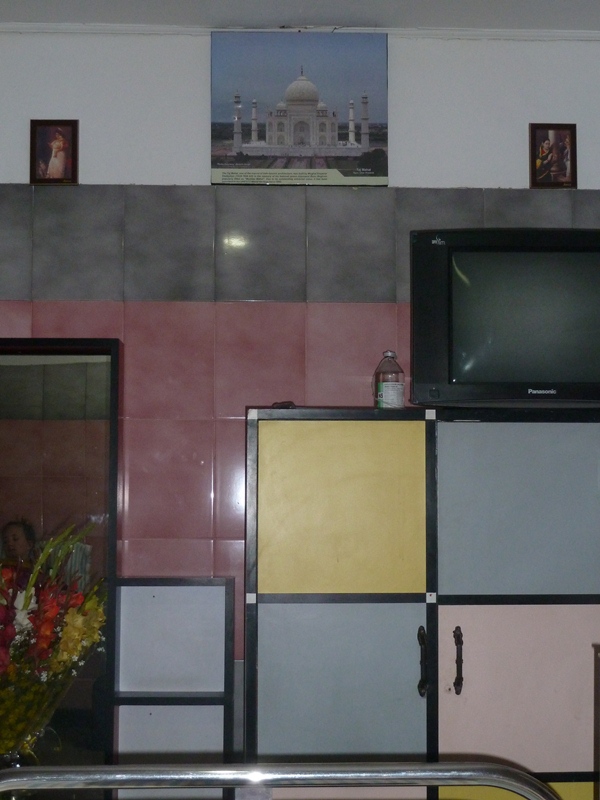

Close but no cigar - viewing a poster of the Taj
As we walk out of the hospital, I don’t even recognise the outside of the place, having been in such a state when I arrived. We’ve made it out alive thanks to selfless love and help from some incredible friends: Pete for dealing with hospitals, drivers, hotels, and for staying in touch with my family; Harriet for discharging me from the “poor man’s hospital”, and constantly making sure we were comfortable; Clare for her texts and phonecalls to my Mum, and calling the travel insurance company; and Erin for sharing new lows and new, new lows.

I've said before that to avoid cultural faux pas in India, I may as well be married to Pete, but this week I may as well be married to all of my travel buddies. After all, they're proving they'll stick with me in sickness and in health – but hopefully not til’ death do us part. 

Thursday, January 26, 2012

Guests are god

Scary puppets, scarier puppeteer
It's not often that the best dining experience of your life is outdone the very next evening. But it happens to us in Ahmedabad. All the tourism websites say that dinner at Vishalla, a 5km rickshaw ride away from Hotel Volga, is a must-do.

Like the Agashiye last night, this restaurant displays a number of The Times of India awards in its candlelit entranceway. We pay the set menu price for dinner at the outdoor restaurant, and are told there'll be a 40-minute wait. Forty minutes almost isn't long enough, as the grounds of Vishalla are fascinating. The area is huge, and set up like a traditional Gujurati village, dotted with fireplaces and smoky with incense that almost overpowers the thick smog that’s enveloping the city this evening.

According to its website, the place is “fit for the purpose, owing to the vastness in the ambience and immense relaxation it offers”. Apparently, the restaurant got its name from a book in which Vishalla is a meditation place: “The name caught the sensitive eyes of Mr Patel [the restaurateur], as it related to his vision for the restaurant – a place to have home-like food in a relaxed atmosphere and free mind.”
Dining at Vishalla

We stop by some of the cultural performances going on in the grounds of Vishalla; one’s a puppet show reminiscent of Czech Marionette dolls (albeit slightly more frightening – at one point a puppet snake is flung into the children in front. Very Brothers Grimm). We sit around one of the many fireplaces in the grounds and listen to drummers and bell-ringers, drinking the lemon and ginger juice we're presented when we walk in. I can't help but think that the only thing that would improve this experience would be a shot of vodka in my juice in this dry state. I must be turning into my parents, who managed to pass off their glasses of Lindauer as sparkling grape juice at my 7th form leavers’ ball.

We're called for dinner at 9.30, and are invited to sit cross-legged on mats underneath low tables. A dozen waiters swarm our table and present the most incredible selection of dishes and condiments on top of plates made of banana leaves beautifully sewn together. It is a work of art. A very, very delicious work of art. Like last night, they just keep returning: “More chapathi, madam? More sambar? More dahl?” The meal finishes with more of the caramel sesame seed treats we’d tried earlier, and a bowl of pistachio-flavoured ice-cream, rendering us almost too stuffed to shuffle back to a rickshaw to get home. But shuffle we do, with bed in mind – there’s nothing quite like a Christmas Day-style food coma.
Sunrise in Ahmedabad after the first day of Utturayan

The next morning, still feeling high as kites after our authentic Utturayan experience and five-star thali the previous night, a very rare thing happens. The world’s most notorious not-a-morning-person person (me) suggests a pre-breakfast walking tour of Ahmedabad. Pre-breakfast, pre-coffee, even. Hard to believe, I know.
The walking tour takes us through the heritage area of the city, and along some of the Pols (streets) and Kanchos and Khadis (small streets/lanes). We wander the pols, through secret doors and shortcuts, and come across book markets and plenty of jewellers – Ahmedabad has one of the largest jewellery markets in India. We also pass by a huge number of temples, and our tour guide tells us that in the 600 pols, there are an incredible 1600 temples. The ornate temple we visit is decorated with swastikas, which we’re told are a symbol of the Hindu faith, as well as Jainsim - a religion that promotes non-violence to all living things. Swastikas and non-violence? Seems a little ironic.

Getting lucky, Gujurati style
Also on our tour are a lovely Indian family, a father, mother and daughter who are visiting from another city in Gujurat. The father is an orthopaedic surgeon, and the daughter is following her dad’s footsteps and is in her first year of medical school. Along the way, they buy us chai, help with translation and tell us more about Gujurat. When we see cows being fed and ask whose responsibility it is to look after the thousands of them that roam the streets, the Gujurati family take us over and buy some grass for us to feed the cows with – apparently it’s very good luck to feed a cow on a birthday or other auspicious occasion. Well, it’s not every day you’re in Ahmedabad at Utturayan.

We visit the stunning (and mammoth) Masjid-e-Nagina mosque – the second largest in India, where 10,000 Muslims come to worship every Friday. Interestingly, the mosque’s interior design and architecture includes elements of other religions, and it even displays some of the Hindu/Jain swastikas we saw earlier. The orthopaedic surgeon tells us the man who established the mosque was very liberal, and liberalism at the mosque continues today – amazingly, there’s even a place for women to worship. Very progressive.
Speaking and hearing no evil at Mahatma Gandhi's Ashram

After the enlightening walking tour, we head across the bridge to the Petang Tower in search of breakfast, but the menu is Indian only. I’ve been embracing Indian food for lunch and dinner, but I draw the line at pre-midday chili. We walk on, and a short time later I make an elementary mistake. Walking with my head down to avoid the human faeces underfoot, I forget to look up for a short time and smash my head at full pace into a tree overhead. Searing pain ensues. I still don’t have my eggs for breakfast, but there’s now a large one on my head. India 101 – not only look both ways, but look up, down and all around at all times.

In the afternoon, we’re tempted to abandon the idea of visiting any other tourist attractions, but eventually decide on visiting Mahatma Gandhi’s Ashram. I’m so glad we do, as it’s one of the most fascinating places we’ve visited so far. We spend the afternoon reading about Gandhi’s many principles and beliefs, and learning more about his “non-cooperation” movement and his practice of non-violence.

There’s not enough time to take all of Ghandi’s teachings in, but I promise myself I’ll find out more about his work when I’m home. Barn buys a biography and I buy a quote book for my brother-in-law, before we head to the pentagonal lake on the other side of the city, which is packed with Indian families celebrating the public holiday.

More kite flying in Ahmedabad
It’s nearly time to head to the airport for our flight to Delhi, and on our way to the rickshaw, we get more waves from families flying kites on their rooftops. One calls down to us to come and join them, and initially I’m not sold. We’ve done the rooftop thing already and should get to the airport pronto to go through the rigmarole of checking in for domestic flights in India – it’s no Air New Zealand self-check-in and baggage drop system. But Barn convinces me otherwise, and it turns out to be sensational. The sky is bluer than yesterday, and kites flood the skies. We’re now the new best friends (and Facebook friends) of another Indian family who teach us to fly kites, offer us masala fizz and beg us to stay for dinner on their rooftop, which is pumping Indian beats across the neighbouring rooftops from a huge speaker.
Pre-E.coli: "I love India 2012"

We eventually have to take our leave, but exchange email addresses and phone numbers. Soon afterwards, Barn gets a text from Darpan, the 20-something-year-old civil engineering student of the family, saying: “Ya, we enjoyed the day but we were missing you guys. I would be pleased if you come to my home for a spicy Indian dinner, and give my love to beautiful lady Rebacca.”

We’ve had an incredible time in Ahmedabad and been welcomed so warmly into people’s homes. The rest of Darpan's text sums it up perfectly, by saying: “And don’t say thanks to me, as we Indians always treat guests that way… ‘Atithi devo bhava’ – it means guests are god.” 

Thursday, January 19, 2012

High as a kite

Arriving in Ahmedabad
As expected, but as clichéd as it sounds, landing in Mumbai is an eye-opener. Slums occupy a huge amount of the city, but are broken up by pockets of desolate apartment blocks and half-finished high-rises. We’ve had to slash Mumbai from our itinerary to fit Illam and the kite festival in, so when we land in Slum City en route to Ahmedabad, we hope they’ll let us off the plane, so we can at least say we stood on Mumbai soil. Considering our surroundings, it’s completely inappropriate to say we’re “starving”, but the other reason we want to get off the plane is that we’d love a feed; breakfast was hours ago.

Pete asks if I reckon Mumbai Airport will have a McDonald’s, and I respond with a very disapproving look, lips pursed (we haven’t caved and had Western takeaway food yet). He reminds me he’s one up on me after he had a masala dosai and sambar for breakfast the other morning when I opted for jam and toast. Defeated, I finally agree he can give Maccas a go, provided he has a Chicken Maharaja-Mac, a BigSpicy Paneer wrap or something strictly Indian. His hopes are dashed, though, when the airhostess announces (first in Hindi, then in Tamil, and lastly in English) that we’re to stay put.

As I flick a text to my sister, I glance over and see Pete googling “McDonald’s Ahmedabad” on his iPhone. Snapped. Apparently there are three McDonald’s restaurants in the city, but Ahmedabad has a huge range of well-regarded eateries (actually, more than half of the top 20 things to do in Ahmedabad are cafes or restaurants), so I think we’ll try and steer clear of the golden arches. We arrive at a much more glamorous airport than Chennai, and read up on Ahmedabad in our taxi into the city – the highlight of which is yet another jaw-dropping red sunset. Apparently Ahmedabad is the fifth largest city in India, and has a metropolitan population of 6.4 million. According to Wikipedia, Forbes magazine rated Ahmedabad as the fastest-growing city in India and the third-fastest in the world, in 2010.

On the way to our hotel, we spot some kites in the air, and work out our plan of action for the kite festival, known here as Utturayan. In light of the day being a national holiday, and with many of the city’s attractions being closed, Barn sets us a challenge for how we’re to spend Utturayan. “We need to do some serious friending,” he declares. “Imagine how much more amazing it would be if we’re invited up onto a roof to fly kites with an Indian family!” I tell Barn I’m quite good at befriending people, and get slated for it by some of my workmates – one in particular, who I think is mildly envious of my superior BFFing skills (just kidding, Gemma). The challenge Barn sets is quite specific; his preference is for an Indian family with the following: “At least one elderly, just for character, a couple of small children, and someone our age – or late teens.

Rooftop dining at House of MG
Challenge accepted, our taxi pulls up at Hotel Volga, which isn’t as uncouth as its name suggests, even though a dog promptly vomits on the doormat outside shortly after we arrive. We’re shown a selection of reasonably priced rooms, and regrettably turn down the one with the 1970s circular double bed, choosing a twin room with air-con, but no external windows. The boy who collects our bags and shows us to our room empties three-quarters of a can of asphyxiating lemon air freshener into the windowless room before we can stop him. He asks where we’re from, and when we say “New Zealand”, he smiles and says, “Stephen Fleming”. What is it with Indians and Stephen Fleming? A quick google tells me he played in the Indian Premier League in 2008, something I’d no doubt have known, had I had brothers instead of sisters.

We’d made a dinner booking at the city’s “House of MG” (officially called The House of Mangaldas Girdhardas), a beautiful heritage mansion converted into a hotel and famed for its three-course Gujurati Thali meals. Upon arrival, we’re greeted by the assistant manager of guest relations, who had responded to my earlier email with “Dear Mr Rebecca Kennedy” (I think I almost prefer Rrrrooopka to Mr Rebecca) and we confirm that yes, we’ll go for the deluxe dining experience over the regular one. We’re going all out, splashing 600 rupees each ($15).

Agashiye - Ahmedabad's best dining experience
Lonely Planet promises that Agashiye is Ahmedabad’s best dining experience – a claim that turns out to totally deserved. I’d go as far as saying it’s the best dining experience I’ve ever had, anywhere, but admittedly I’m still waiting for an invite to dinner at Logan Brown, so I don’t have much to compare it to. We’re served drinks and traditional Gujurati canapés of Dalvada (deep-fried dumplings) and Dohkla (steamed split beans/rice cakes) as soon as we reach the terrace, and are then escorted to a candle-lit area with fairylights and outdoor fireplaces overlooking the city.

Patang (Kite) Markets
We’re served our main course (countless delicious vegetarian dishes such as Sarson Da Saag (green vegetables and mustard leaves), Paneer Bhurji (mixed vegetables and scrambled cottage cheese), breads, curries, and rice) by more than 10 chefs who roam the rooftop refilling our plates as soon as we’ve finished each mouthful. When we beg them to stop, they clear our dishes and serve dessert of dried fruits, stuffed betel leaves (that we’re not overly sold on), home-made chocolates, and coffee. After dinner, we brave the Patang Markets, where all the kites are sold. It's lovely to see all the brilliant colours of the kites, but it's less lovely to be jammed up against with thousands upon thousands of others and be groped by teenage boys; we get out of there as soon as we make it to the other end of the street.

The next morning, I pass up Barn’s offer to join him for a 6am sunrise walk – even though I really should after last night’s dinner – and have a much-needed sleep in. In my defence, it is a Saturday, and travelling really does take its toll. In preparation for tackling Utturayan, we have a late breakfast at a more casual café, The Green House, at the front of the House of MG, and go over the befriending strategy.

Adalaj Stepwell
Jumping in an autorickshaw, we head over to the other side of Ahmedabad and visit the Law Garden, opposite the city’s Law Society, and then wander the streets (passing one full of huge monkeys slung over front gates and in windows of people’s homes). We make our way to a Hindu water building called the Adalaj Stepwell, built in 1499 for Queen Rani Roopba (now I know why they all think my name is something like that). It goes five storeys underground, and our rickshaw driver happily takes us down and shows us inside. Pete takes a look at the mosque next door (“not woman allowed”), and I crane my head in search of kites. We shake off our rickshaw driver who doesn’t understand why we’d want to go for a walk around the area, and the BFFing begins.

We look up and see crowds of people gathered on the rooftop of an apartment block. They smile and we smile back. They wave; we wave back. They motion for us to come upstairs. We look at each other and nod – our strategy is going perfectly to plan – “Textbook friending,” Barn says.

The wave that got us invited up to the rooftop
The rest is history – we climb four flights of stairs to the top, and are instantly mobbed by the dozens of extended family members gathered there for Utturayan celebrations. Kites, food, drinks. We’re offered beer and whiskey, despite Gujurat being a dry state. I politely refuse, but Barn has a Pepsi and Whiskey, followed by a straight whiskey when the Pepsi runs out.

The women crowd around me, the men around Barn. We watch them fly kites, we fly kites. We chat to them, meet their cousins, wives, daughters, sons, brothers, sisters and neighbours. I’m handed a child to hold for a photograph, then another. Suddenly there are many little Indian children hanging off me and I’m posing for photograph after photograph on their mothers’ mobile phones. We’re fed traditional Utturayan sweets of peanut brittle, caramel-flavoured sesame seed treats and something made with rice bubbles.

Kite Festival-goers handing me their children for photos
We’re introduced to the best friend of the man of the house (who’s getting quite tispy by this stage and actually declares Barn his new best friend). The original best friend happens to have lived in Christchurch for the past 10 years, running a Guthrie Bowron store there, so we chat to him about New Zealand, and he helps us book another highly recommended restaurant for dinner, despite the family’s protestations that “Peeeeterrrr and Rrruuupeka” stay to share a meal with them.

Exhausted from all the activity, we bid the family farewell (which takes longer than saying goodbye to all the cousins at a Hallagan/Kennedy family do back home – no mean feat, as anyone who’s experienced a Waipukapalooza or Chinese Banquet at Box Hill would know).

Ahmedabad family and their new 'best friends'
I’m not quite game enough to negotiate the traffic on foot around here, but Barn braves it and heads out for a run along the river, while I spend the rest of the afternoon back at The Green House café listening to the cacophonous traffic trying to out-do the wailing of sunset prayers at the mosque. I sip lime sodas and order more of the patra steamed leaf snacks we enjoyed last night, so content in the knowledge that we nailed the Utturayan experience that I can’t wipe the goofy grin on my face. Anyone would think I’m high as a kite.


Our rooftop home for Utturayan