Showing posts with label taxi drivers. Show all posts

Tuesday, January 31, 2012

In sickness and in health

Slapping cockroaches dead on trains - a novel way to pass time
We catch an overnight train back to Delhi from Varanasi the next day, after returning to Blue Lassi with Harriet in tow, Erin refined to bed rest again. The train is only 14 and a half hours this time, but it still passes rather agonisingly, thanks to the endless stream of cockroaches scuttling up and down the walls and floor our carriage. I spend the majority of the night on cockroach watch, slapping them dead with my jandals, and thanking my lucky stars we have a driver and flights booked for the remainder of our transport in India. It’s at about 3am – when we’re still nowhere near Delhi, the snoring from the Indian man in the neighbouring cabin is becoming deafening and the ‘roaches are seemingly unconquerable – that I start to think my family’s trip to Melbourne to see the Australian Open tennis is looking like a much more appealing option than India. What was I thinking?

I doze off to sleep just in time to be woken up as we pull into Delhi at 7am. It’s a cool 4 degrees when we hop off the train, but waiting on the platform for us is Vishnu, our driver for our tour of Rajasthan. Vishnu, “like the name of Indian god”, he proudly says, is a tiny man in a bright purple jersey. He has thighs the size of my forearms, very dark skin, a moustache, goatee and a cheeky smile. For the car, Vishnu on call 24/7, petrol and taxes, it’s only costing us $200 each for 10 days. A total bargain.

We’d specified a vehicle with seatbelts, a very careful driver, and one who speaks English. Vishnu takes us over to our car, which is described on our itinerary as a SUV but is more of a people-mover. It’s white, and has the word “TOURIST” emblazoned in large capitals on the top of the front windscreen. Could we be any more obvious? After some fumbling, we locate all the seatbelts, and set to the roads. Vishnu is indeed a careful driver, but his English leaves a bit to be desired. Oh well, two out of three ain’t bad. 

The Famous Five Do Rajasthan
It’s a slow start as we crawl through the extreme fog covering Delhi, but the roads of Rajasthan are more like real roads than any others we’ve travelled on so far. The drive to Agra passes relatively painlessly (although, to be fair, I’m asleep most of the time), and when we arrive, we take photos of the Taj Mahal from our bedroom windows. As Vishnu’s English isn’t the best, the tour company is supplying us with guides in each city; shortly after arriving, we meet our Agra guide and have some lunch, before a minor drama unfolds: Clare misplaces her small handbag containing USD $500, credit cards, an iPhone and passport. We comb the restaurant and cross-examine the staff members, but later return to let them know that all is well – the handbag has been located at the hotel. Crisis averted. We head to the Red Fort (Agra Fort), overlooking the Taj Mahal, where we will visit tomorrow, as it’s closed for worship each Friday. 

King Peter and his princesses at Agra Fort
At the Red Fort, we pose for photos with Barn sitting on the King’s seats, and us (his four wives/princesses, as we’ll now be known) surrounding him. The tour guide shows us a secret room with walls filled with water, and we have more fun than 25- and 26-year-olds probably should whispering into one corner of the room, and hearing what the other person is saying just like a phone line in the opposite corner, 10 metres away.

Before the day’s tour ends, we have to visit a marble factory and another sales spiel. Today’s is like a carefully scripted play – the shop owner has his lines down, and his assistants all switch the shop lights off in unison as a torch is shone beneath a marble table to show us the colourful stones in all their glory. We get away without purchasing an outdoor marble table, but Harriet takes one for the team this time, buying the smallest marble elephant they have.

That night, we dine in the company of a throng of Korean tourists at Joney’s Place, highly recommended by friends and all the guide books. We sample more Indian delights and wash them down with lassis before heading back to our ‘VIP suite’ which isn’t all that VIP (cold saltwater showers, which eventually turn into lukewarm saltwater showers). We lay out our best Indian outfits for the morning – we’re getting up at 6.30 to go to the Taj Mahal at sunrise – and head to bed, excited about the day ahead.

And then it all goes horribly wrong.

I wake up at 1am and power-chuck the contents of my dinner into the toilet bowl. Thinking I feel better, I head back to bed, only to wake up every 20 minutes for the next eight hours to vomit up copious amounts of the brightest yellow bile. It’s like clockwork. Excruciatingly painful clockwork. Twenty minutes, to the minute. I’ve never been this sick in my life and as clichéd as it sounds, I would never wish this upon my worst enemy. It’s a living nightmare.

In the morning, I’m lying in the foetal position on the camp-bed by a heater, and groan a farewell to the others as they head to the Taj Mahal – the supposed highlight of a tour of Rajasthan. In fact, it’s probably the highlight of the whole of India. I’m in Agra and I’m not going to see the Taj Mahal; this is unbelievable. When the crew return, they try to hide how amazing it was from me. “It was freezing cold,” says Harriet. “Taj schmaj,” offers Clare. I bet it was incredible.

The next few hours pass in a blur as the team decides we can’t travel to Jaipur today as planned. They find a new hotel, and take me to the general hospital next door, which looks like it’s the set from a 1930s war movie. Everything is rusty and broken, and there are sick people everywhere. I’m helped into a wheelchair and taken to be examined by a doctor who loudly asks over and over again “How many times vomit?” and “How many times defecation?”, which does bring the tiniest of smiles to my ashen face. I’m admitted overnight and sent to a very cold but private ward next to a public ward with dozens of Indian mothers and babies lying over beds in every direction. I hand over the 2000 rupees ($50) for my room, give the doctor my passport and am examined again by a host of what I think are trainee doctors and nurses on rounds. The room is packed, but hardly anyone can speak English, so much of our communication (or rather, miscommunication) is mimed.

The cleaner, of all people, comes back in and hands over a list of around 15 medications, written in Hindi. She hangs around and awkwardly stares at me for an age, until Barn comes back into the room and subtly lets me know that someone in the carpark has told them that this is the “poor man’s hospital” and that we should be at the “rich man’s hospital” down the road. Sure enough, Lonely Planet also suggests the “rich man’s hospital”, more formally known as Amit Jaggi Memorial Hospital. 

Hospital number one, a fridge
Before the cleaner gets her chance to pump me with unknown medicines, Harriet spends almost an hour discharging me and signing countless forms, while Clare calls BNZ TravelCare to tell them I need to cash in on my policy. Because we’re self-discharging, the nurses no longer let me use the bathroom, instead pointing me in the direction of the filthiest squatter located in the burns unit when I’m about to be sick again. I run outside and vomit in the carpark instead. New low.

Eventually Harriet returns to the car with my discharge papers, and we even get back the money for my room, bar a 160 rupee admin fee. Vishnu then takes me to Amit Jaggi Memorial Hospital, where I’m instantly seen by Dr Jaggi himself, Senior Physician and Medical Director. Dr Jaggi’s office looks like a much more legitimate excuse for a doctor’s surgery, with degrees and diplomas adorning the walls, and the latest medical textbooks on shelves. This is a good sign. When Dr Jaggi asks my name, I groan “Rebecca”. He smiles, “Ahh, you must be Rebecca Kennedy. Your travel insurance company has phoned me already. I will call them back to let them know you’re here.” I nearly cry with relief – the man speaks English and he knows who I am.

Dr Jaggi says I have a “very bad bacterial infection” and am “extremely dehydrated”. A whole team of doctors and nurses march into my hospital room and try to find veins in my arms for about quarter of an hour, the first three attempts being unsuccessful. My right arm is squeezed black and blue and a vein is finally located, and I’m pumped with I/V fluids, and given general antibiotics while my bloods are tested for what the bacteria is. I feel so awfully nauseous that I’m in tears, almost hysterical, and that’s when Ali, one of Dr Jaggi’s assistants, announces that he is about to inject something in my backside. New, new low.

Ali smiles at me and exclaims far too happily, “No, no, no, no, no, nooooooo worrrries!” Well, maybe not for you, Ali. He means well though, and quickly becomes an ally in this battle against my own body. In the afternoon, Erin decides to get checked out by Dr Jaggi too, as she hasn’t been feeling very well since last week. She’s admitted into the same room as me, and is great company and moral support as further excruciating injections are endured and more new lows eventuate.

Not quite a tequila sunrise
I sleep the whole next day and miss the others when they come in to make a new travel plan. In the end, they decide to push on to Jaipur while we stay another night in hospital, and they arrange for a driver to come and collect us when we’re discharged. Erin and I talk to our families, and then spend the evening watching movies on HBO, including Sex and the City 2 – The Movie, and – aptly – Slumdog Millionaire. I even catch a bit of one of Caroline Wozniacki’s matches at the Australian Open, and don’t feel so gutted about missing it in person.

On our third day in hospital Dr Jaggi confirms that our cultures showed we had E.coli, and says we’ll be able to be discharged in the afternoon. The young doctor who’s been treating us (‘DK’ as he tells us to call him – not to be confused with TK from Shortland Street) administers even more antibiotics and one last injection each in the backside. They send us on our way with very best wishes and little brown paper bags of medicines to see us through the next four days.
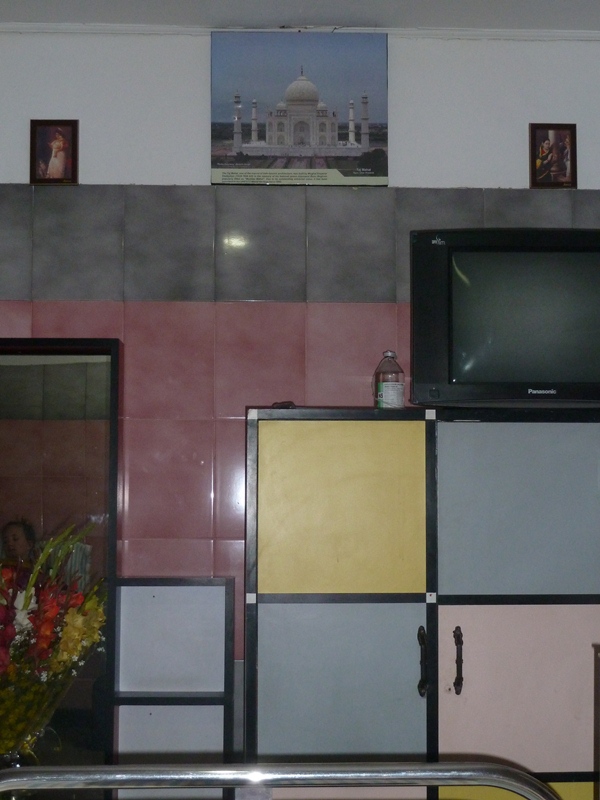

Close but no cigar - viewing a poster of the Taj
As we walk out of the hospital, I don’t even recognise the outside of the place, having been in such a state when I arrived. We’ve made it out alive thanks to selfless love and help from some incredible friends: Pete for dealing with hospitals, drivers, hotels, and for staying in touch with my family; Harriet for discharging me from the “poor man’s hospital”, and constantly making sure we were comfortable; Clare for her texts and phonecalls to my Mum, and calling the travel insurance company; and Erin for sharing new lows and new, new lows.

I've said before that to avoid cultural faux pas in India, I may as well be married to Pete, but this week I may as well be married to all of my travel buddies. After all, they're proving they'll stick with me in sickness and in health – but hopefully not til’ death do us part. 

Thursday, January 26, 2012

I hope you like the scarf

Clare, Uttam and Pete
The autorickshaw Uttam drives now is one he rents for around Rs 200 per day. “I pay for tyres, brake pads, brake fuel and so on,” he says. Pete asks if he’ll buy his own one day, and he tells us he’s saving for one, but saving is tough going.

I enquire about the Indian driver licensing system. Apparently, it exists. All up, it costs several thousand rupees to become fully licensed. First up they have to sit a learner’s licence – “You can sit that when you are 18. Then you go for private licence within one to six months, and then after three years you can go for government licence,” Uttam says. “That one gives you discounted medical care – they pay 25 per cent if you have a crash – and other benefits too. But not if you crash when you are driving drunk,” he adds. “You need to renew your government licence every three years, as well. And then you can get your commercial licence, but the government licence is good enough, so I do not need this one. Uttam tells us the government licence costs around Rs 3000, but it can change “according to goodwill”. Uttam says, “If you know someone in government, it can be little bit cheaper, say, 2500 rupees only.” It seems the notion “It’s who you know, not what you know” is universal.

Barn’s phone rings in the rickshaw, and it’s an Indian number calling. We assume it’s a hotel about a booking, but he looks confused and repeats the caller’s introduction. “It’s my new friend calling? Sorry, who is this?” He explains when he hangs up that it was a customer service representative from Vodafone India who he had spoken with earlier in the day when he was having issues with his sim card. The first time they spoke, Barn was having trouble remembering his new Indian number and she had given him a lecture: “You are verrrry confused, sir. Please write down your number on a piece of paper, and then read it out to me exactly as it is written down.” Just as they were making headway, he accidentally put her on hold and the call was disconnected. Amazingly, this girl displays exceptional customer service contradictory to my earlier rant about Vodafone. She had saved Barn’s number and rang him back from her personal phone when her shift was over, to see if the issue had been resolved. Ten points, Vodafone India. She then proceeds to call him back five more times in a stalkerish manner. Negative ten points, Vodafone India.

Our tour of Varanasi finishes with a trip to the Muslim Cooperative Society – the oldest manufacturing area in Varanasi. A Muslim man shows us around, and we bypass the mosques and head down some alleyways to see silk khadi (hand weaving). We’re told it’s a slow process, with some Muslim dresses taking five to six weeks to complete. A group of men and a young boy are painstakingly threading silver beads onto a piece of silk and explain that silver ones are used for wedding garments only. We meet another man who’s weaving 7000 Kashmiri silk threads finer than strands of hair on an ancient leg-operated machine that has programming cards with codes for different patterns. It’s the same kind of device they’ve been using since the 14th century, and we’re told it’s like an early version of a computer. Again it’s painstaking work; “I’m going to look at my pashminas differently now,” Clare says. Me too.

The man showing us around says they export to lots of countries: “Europe, the USA, Jordan, Dubai, Australia – many, many counties.” “New Zealand?” we enquire. “Many, many countries – but no, not New Zealand. You know Australia? We export our bedspreads for 8000 rupees to Deevad Joes.” “Ohhh, David Jones!” we chorus.

No more duvets, please!
Before we can return to Uttam in the rickshaw, there’s a catch. There’s always a catch. We have to visit the man’s silk store, where he proceeds to unfold all the king-sized silk duvets he has, trying to tempt us to buy. There’s ones with pictures of the fort we visited this morning, more with elephants. Initially, none of us has the heart to say we're not in the market for duvets, but as we slowly drown in fabric, we shake our heads, saying we can’t take any more luggage. But he persists. “We can post!” he says, continuing to unfold. “They’re washable in liquid soap!” he enthuses. “Made from baby cocoon silk!”

He gets out some Rs 3000 ($75) pashminas made from the tummy hair of Himalayan goats. “We have ones from the beard part, too!” he exclaims. "God, they're expensive," Barn mumbles. We start to look at each other. There’s only one thing to do now. One of us will have to buy something so we can escape. I should get my mum something nice, but not $75 nice (sorry, Mum). The man looks at Barn, suggesting he buy a scarf. “He doesn’t have a wife,” I say. “Girlfriend?” the man replies. “You like the green one, sir? Maybe for a business friend?” We all laugh, imagining Barn buying one for his new boss at Russell McVeagh.

At this point, it’s getting dire. I ask if he has any cheaper ones and he brings out a pile that are only 50% pashmina, for Rs 300 ($7.50). Taking one for the team, I pick up one the colour of Mum’s mother-of-the-bride outfit from my sister’s wedding last year. “I’ll take it!” I say, not even bothering to bargain with him. I hand over the 300 rupees and we bolt out of there.

On the way back to our hotel, we ask more about Uttam’s marriage. He says he’s 24 and has been married for two years. Despite his family’s protests (he was meant to have an arranged marriage with a family friend’s daughter), he married for love. “I met her in Assi [Assi Ghat]. I see her one or two times, and we talk. Then friendship turns to love.” In Indian marriages a girl’s father has to pay the husband – it’s a tradition from hundreds of years ago. The government is trying to outlaw it, as apparently it’s not uncommon for women to be murdered after their dowry has been handed over. But Uttam reckons the government can’t do anything about. “For good family, nice family, you just have to pay. But she have no dowry, she have no money, but I say I can do without that.”

They had a small wedding, marrying in a temple, with just a few friends there. “My family would not attend, and her family would not come either.” Uttam tells us that he had great support from a Swiss girl, Anna, who he met when she was volunteering for Red Cross in the area. “She was good friend, she support me a lot and help me, but she’s gone back to college, to university now. Maybe she will come back again, she said maybe in five years, so maybe in 2015,” he says, with a sadness in his eyes.

Taking one for the team
When we get back to the hotel, Erin and Harriet have deteriorated. The poor things are in pain and in need of medical attention, so Barn calls the doctor. One arrives around 7.30pm, diagnoses the girls and prescribes a host of medicines. Barn, the legend, then hops on a motorbike driven by the hotel manager, in search of a 24-hour pharmacy. He’s gone for what seems like an age, and returns, valiant, medicines in tow, having visited six pharmacies. They’d also had to make a return visit to the doctor, as he’d prescribed a medicine that either did not exist or was not available in any of the five pharmacies visited previously. What a champion. At 9.30pm, we dose the girls up and send them to bed, before we head to the rooftop restaurant of our hotel for some dinner and to get Barn a well-deserved beer after a frantic day in the Holy City of Varanasi. Mum, I hope you like the scarf.

Hard work in the holy city

Sleeper train to Varanasi
Arriving in Delhi, Barn and I can’t believe how Western the city feels, relative to the other places we’ve visited in India. Road rules clearly still don’t exist here, but there’s slightly less tooting on the roads as we leave the airport. Furthermore, they’re roads which actually resemble real roads. This is a first. We ask about the 2010 Commonwealth Games and what we glean from our driver’s broken English is that the city was cleaned up in a huge way before the Games – a bonus for those living in Delhi.

We meet up with Harriet and Erin at the hotel and try not to share all the news of our past 10 days apart, as we have a 17-hour train ride to Varanasi the next day. When we get to the platform, Barn reminds me that we’re going to be spending longer on this train than we have in most of the hotel rooms we’ve stayed in so far – not a comforting thought.

As we board the train, a man pushes in front, separating me from the others. He’s stalling, looking into each cabin as I try to push past to get back to the group, and I realise his friend is right up behind me. I feel something touch my handbag, and quickly pull it closer to me before stopping at a seat and insisting they both pass. When I look again, I realise a 20cm hole has been sliced into my bag. Fortunately, the cut was made right where my sleeping bag liner and jersey were, so nothing was taken, apart from my naivety, perhaps.

The Ganges at dawn
The train passes as slowly as expected, and we arrive at Rahul Guest House on the banks of the Ganges in Varanasi at 5.15am. We have a much-needed coffee and board a boat at 6am to watch the sun rise over the Ganges. It’s a must-do experience, but not one I’d jump at repeating any time soon. We float through thick fog past the ghats where some bodies are being burnt and others are being tied with rocks before they’re released onto the water to sink.

The Ganges
There are boatloads of other tourists doing the same thing we are, and others with men selling tacky Varanasi souvenirs from them. It seems wrong for people to be capitalising on this situation, but where there’s a rupee to be made in India, you can guarantee somebody will be making it. Nearing the end of the journey, a Canadian on our boat comments that it’s interesting we haven’t seen a corpse yet. Less than 30 seconds later, we pass one floating face-up. I can’t look for long, but the corpse is still well formed and you can tell it’s a man. There are crows sitting on the man’s bloated stomach, and ceremonial paint still adorns his forehead. He even has his silver wristwatch on. It’s creepy, to say the least.

We walk the city in the afternoon, try a thali recommended in all the guide books, and navigate the intense traffic. After dinner at a restaurant overlooking the Ganges, we meet another lovely autorickshaw driver, Uttam, who we enlist to take us sightseeing the next day. On the way home, Uttam proudly shows us the sparkly Indian bangles he’s brought his wife, and we tell him he’s chosen the best ones. He smiles, stoked, and tells us that in India, it’s not common for men to buy their wives gifts. He tells us he’s 24, two years our junior, and asks Barn if he’s married yet. “Unfortunately not,” he says, “But I’ll be buying bangles soon enough,” Barn adds, laughing.

Clare arrives off a train from Delhi in the morning, and we begin the day as a foursome; this should be the start of “The Famous Five do Rajasthan and Uttar Pradesh”, but Erin is struck down with an as yet unknown illness, so Pete, Harriet, Clare and I head off with Uttam while Erin rests up. He takes us first to the Ramnagar Fort and Museum, a 17th century fort and palace on the eastern banks of the Ganges. We wander through the slightly underwhelming museum and look at cases of weaponry – Indian swords with flint lock pistols, axes, daggers, some bejewelled swords, and a lot of empty cases that should be holding ‘ivory articles'. There are elephant tusks, and – bizarrely – a relatively modern Indian lounge suite behind glass. We see tiger heads, animal hides, a lion trap, and a once-beautiful ballroom with leadlight windows that’s sadly now in a state of disrepair. Pete reckons it would have been a great 21st venue in its heyday.

Harriet starts to go downhill, so we drop her back at the hotel for some R&R with Erin, while Clare, Pete and I continue on to Blue Lassi for “The best lassi in all of Varanasi” – an advertising slogan Clemenger’s would be proud of. This place has been talked up by everyone who’s ever visited the city, and it’s unfortunate Erin and Harriet aren’t with us to enjoy our first one as they were huge campaigners. We’ll have to come back tomorrow, we say. On the way there, Pete accidentally says “bang lassi” instead of mango lassi (Freudian slip?), and our driver Uttam launches into a big spiel about “bang lassis” – the drug-laced version of the milky drinks. Pete’s pleading, “No, I didn’t mean that! We do not want the drug version!” but Uttam presses on. “Bang lassi you can only buy one day of the week in Varanasi. It is very dangerous. The marijuana last four hours, but bang lassi lasts 12. It’s made with the baby leaves,” he says. “It have delayed reaction – you not feel it for one and half hours. Easy to have too much.”

He admits he’s tried it many times before – but he doesn’t do it these days, now that he’s married and has a 10-month old son. “The feeling is very nice, but you can only have little bit, no more. But it is not good; you drinking more and more of it and you become mad. Things are always running in your mind. Anything you think of – the spiritual matters, the sexual matters. You are always thinking, deeper and deeper, any matter,” he warns. “Not long ago, tourist come here and he have the bang lassi. He was in the street for six hours – six hours! – playing with dolls like a baby. More than 200 peoples were watching him in the street, and he not watch any of them, he just watch the doll.” 


Clare ready to tackle 'The best lassi in all of Varanasi'
We get to the lassi place and I opt for a banana and coffee flavoured one. Pete tries the Lonely Planet-recommended apple, and Clare a banana coconut. As we’re ordering, the owner says, “We have special lassi, magic lassi. We can get a lot of things here. We can add magic seeds.” Uhhh, no. Definitely no magic seeds, thank you very much. In her job at Telecom, Clare’s doing some work for Fonterra, so she films them churning the milky drinks, and asks about the ingredients. “Milk, cream, saffron, rose water, and pistachios,” they say. They tell us it’s buffalo milk, not cow, and when we leave, we quiz Uttam about the Indian dairy industry. He tells us buffalo milk is Rs 20 per little, whereas it’s Rs 40 for a litre of cow’s milk. He adds that the buffalo milk is stronger and you can add 300mL of water per litre to dilute it. Apparently they save the cow’s milk for ceremonial use – it’s one of the offerings to the Hindi gods. Temples are even washed in the stuff. “We have big shortage of cow’s milk when we have big religious ceremonies – this is 14 times a year.”

Uttam picks up his sister’s 10-year-old brother on the way, and we say hello and ask if he goes to school. He doesn’t. He sells postcards to make money for his family. He’s one of 11 children and there’s no one to pay for his education. Uttam tells us more about his own family – one brother and one sister, both married now. His father died when he was nine, so he’s been working since he was just 14 years old. First, it was “small jobs like chai shop,” he says. “I started driving auto in 2008, but I do one year learning in 2007. I work one year for no pay to learn.” Clare says that must have been hard, not earning any money for a whole year. Uttam replies in an unintentionally poignant manner: “In India, to get something you need to lose something.” We all nod and look down, silently and unanimously agreeing on the value of hard work.

Tuesday, January 17, 2012

Everything in moderation

Long story short: we made it
The interstate journey over the Western Ghats from Tamil Nadu to Kerala is one of the more harrowing afternoons of my life. Alleppey, our next destination, is around seven hours away, but the distance seems infinite right from the minute our crazed taxi driver accelerates into the path of an oncoming bus as we leave the tranquillity and loveliness of the Karunai Illam children’s home. 

When the driver swerves in front of several more vehicles and pulls in to a petrol station, I insist he opens the boot so I can rummage around for the seatbelt clips. The driver barks, as all of them do, that there are no seatbelts "een Eendia". I tell him we found some last week, and turn to Pete and hiss that the driver is definitely lying. He’s not. Rummage I do, to no avail. The clips have indeed been removed from the car and only the metal springs remain. I throw as much of a tantrum as I think Barn will put up with, before realising there’s actually nothing we can do. There were no trains to get us there, and the bus was going to be 12 hours long, overnight – which is an absolute no-no on the roads we’re traversing. 

Desperately tired from a very late night and our 4.20am start, I try for hours to keep my eyelids from closing so I can scream at the driver to slow down or to not overtake, as required, but watching the tea plantations whiz by, I drift off a couple of times. For the next few hours, Pete and I take it in turns to keep an eye on the roads – not always telling each other about the close calls we see. For most of the journey we’re on roads like the Rimutakas, but at an altitude of more than 2500m, and the traffic is backed up bumper to bumper. The tooting is constant, and buses overtake other buses on blind corners at high speed. 

When we reach the very top of the Ghats at around 7pm, we suggest a stop (more for the driver’s sake than ours) and have a morale-boosting coffee and a box of the homemade chocolates that southern India is famous for – and that we’ve become quite fond of. 

The sugar hit helps us remain on high alert after a 20-minute delay caused by a car accident further down the road. We have no idea of the details, as the people running around in the dark discussing the crash speak only in Tamil and Hindi, but the concerned looks on their faces tell us it’s not good news. Incredibly, as soon as the traffic starts to move again, the drivers are back at the overtaking game. We'd like to think they would take heed, but it seems they’re more enraged by the delay, and continue to race even faster. When our driver pulls out to pass on a blind corner not long afterwards, it's the final straw; both Pete and I crack. Using our most assertive (Pete) and terrified (me) voices, we insist he is not to pass or speed under any circumstances. 

Houseboating in Kerala
Somehow, we make it to Alleppey at around 10pm, and high-five as we walk into the lovely homestay we’d booked. Nerves are still frayed, but the notion of a good night’s sleep is just what the doctor ordered. That, and the Kingfishers we demolish over dinner as we once again toast to being alive.

Our trip mimics India’s capacity for extremes, and following our car ride from hell, we experience the ultimate luxury of staying on a houseboat for a night, drifting along the backwaters – a 900km network of waterways in the area. We’re served fresh coconut drinks on arrival, and over a lunch of fresh fish that our personal on-board chef cooks us, we enjoy some of the beers we’d picked up earlier (making the most of alcoholic beverages; the next state we’ll visit, Gujurat, is a dry zone).

Living the good life
Our chef brings us coffees and banana fritters in the afternoon, and then we read, laze about on the deck and listen to music. Our captain pulls the boat up alongside a local fish market, and we choose the biggest blue freshwater prawns for our candlelit dinner. Lonely Planet is right in saying it’s “worth every rupee” (Rs. 6500) and will probably be “one of the most expensive things you do in India” (about $80 each). 

Sunset on the backwaters
After breakfast on our boat at sunrise, it’s back to slumming it on an autorickshaw, taxi, train, another auto, feral ferry, and another taxi to get to our next stop in Kochi – a garish yellow, mosquito-ridden, windowless hotel room with a cold shower. I know it couldn’t last forever, but the good life was really good. We’re back to being intrepid travellers for the next few days, and I can’t help but think Oscar Wilde hit the nail on the head when he said, “Everything in moderation – including moderation.”

Room with a view

Monday, January 9, 2012

Lions and tigers and bears, oh my!

On the climb up to the hill station of Kodaikanal, the temperature drops considerably. We’ve come from the sweltering heat of Thailand and Malaysia, and then Chennai, Mamallapuram and Pondicherry in India, and now goosebumps are appearing. The Icebreakers that were exiled to the bottom of my bag when we arrived in Asia are now incredibly appealing, and the pain in my shoulders from my heavy pack suddenly disappears.

As we wind through the hills, our driver, Mr Sidiqque, commentates. "This road was opened in 1826 for the England people," he informs. "Till now, not even damage to this road. We have cyclones and still no damage – it is very good road." He asks about our travel plans, and tells us about the best house boats to stay on in Kerala next week. Pete enquires about Berajim Lake in Kodaikanal, and the surrounding sholas (forest) area. “Ahh yes, I know this lake. You get ID and permit. This is no problem, we arrange this for you,” he kindly says.

Kodai, as the locals call it, is 79% forest, and lies in the lush mountains of the Western Ghats of India. Apparently, it’s small, misty, intimate and mountainous. It sounds like a divine respite from the heat-soaked plains we’ve just left. Lonely Planet says the area contains “an incredible array of endemic wildlife”, and Mr Sidiqque further confirms this. "A lot of bison, elephant and deer. Big forest, so they not come to road a lot, but you might see them. A lot of cheetah too. And 22 tigers, total. A lot of snakes. The python, many hill snake – very big and long. Too long,” he cautions. “They have a lot of vegetables, potatoes, 22 varieties of beans, carrots, cauliflower, organic fruits. Orange, avocado, passionfruit. Spices too. Good food in Kodai, and very good peoples.”

Mr Sidiqque says a lot of important people live in Kodai: “The DFO [District Forest Officer], the university vice chancellor, police.” There’s a “100 years old museum, owned by the Roman Catholics”, as well as a lot of schools and colleges. Apparently, 75% of the people are Christian, 15% Hindu, and 20% Muslim. A quick calculation tells me Mr Sidiqque wasn’t in the top maths stream at school, but he continuously checks that we're comfortable along the way, and is a very cautious driver. ”Much better than death-wish, crazed maniacs we had before,” Pete remarks.

Mr Sidiqque says a religious festival takes place on the 14th of August every year, and that a lot of international visitors come. I smile and tell him that August 14 is my birthdate, clearly a great day for festivities of any kind, and he says I must be very lucky. I certainly feel very lucky to be here right now.

As we wind even further up into the hills, the air cools some more and Mr Sidiqque says the temperature here is around 7 degrees at night, and 22 in the day. “Very cold,” he says. "It sounds very pleasant," Pete replies. The streets are filled with Night Queen flowers, like lilies, but they only open at night, so we're driving through at the perfect time to see them in full bloom.

We learn that nanri means ‘thank you’ in Tamil, and hear about the three lakes in the area. “No autos [autorickshaws] here and not a single factory is allowed. Only three years new vehicle, and then you must change vehicle or otherwise get big fine. And no fertiliser. Very clean here,” he boasts.

Arriving in Kodai at dawn
And rightly so. We get to the top of the hill station at 6.15am and it is beautiful. The most incredible multi-coloured sunrise greets us; I'm getting quite used to these. Birds are chirping, while prayers and chanting waft from temples. Mr Sidiqque pulls into the brand new – actually still under construction – Hotel Kurunjimeridian, with a marble staircase in the entranceway. It's perched on a hill overlooking the lakes, town and forests, and we’re the first guests to ever stay in the ‘super deluxe’ room we take. Brand new bedding and cosy woollen duvets – talk about rags to riches.

Even though we’re exhausted from the journey here, it would be cruel to waste a day in Kodai in bed, so we shower and head out into the hills in search of food, yesterday’s thali lunch now seeming like a very long time ago.

Stuffing ourselves in style
Not much is open until 10.30am, so we decide to try a hotel, and find our way to the Kodai Lake. Towering over the lake is the elegant Carlton, and we head straight for the all-you-can-eat breakfast bar. We sit in the sun overlooking the lake, filling up on pastries, cereal, fruit, toast, eggs and (on Pete’s part) some traditional Indian cuisine. After the lack of dinner the previous evening in transit, we’re ravenous and unashamedly eat to the point of explosion. We pay the extortionate price, in terms of rupees, which is a little under NZD $10, and wander the hills, trying to walk off our breakfast binge.

We come across a turkey the size of a large pig, which provides entertainment for a few minutes, and then we continue on our way – pinching ourselves as we go, and keeping a close eye out for lions and tigers and bears.

Move over, Mojo

Indian Railways GA
Our first Indian train ride is a General class metal bench-seat style carriage for the 50-minute journey to Villupuram Junction, and it costs us just 6 Rupees each – about 15 cents. On the way, we meet a tall, young Indian whose name we can’t quite catch through his thick Tamil accent. He’s traveling all the way up to Ahmedabad in the north-west to compete in the Indian National Athletics Championships in the high jumping event. I try to imagine New Zealand’s national athletes travelling like this, and remind myself for the umpteenth time how good we have it back home.

At Villupuram, we have a four-and-a-half hour wait, and there’s not much to do but read, write and avoid making eye contact with beggars. I take photos of the sun sinking behind pink clouds, and the train tracks disappearing into the horizon both north and south. Pete surveys the rest of the station and finds out which platform our next train departs from. When he returns, he tells me he's just been mobbed. “What do you mean? What kind of mobbing?” I enquire. “General whooping, hurraying and handshaking from a group of boys,” he says. “Some women surrounded me, too, but stood at a distance.” At six-foot-something (and white), he does stand out.

In the first class waiting area, another lovely Tamil man befriends us and helps us with the language barrier when a short-tempered lady checking tickets doesn’t approve of our e-ticket via iPhone. The man asks what Pete does for a living, and then looks at me, asking Pete, “Is madam a lawyer, too?” I smile, bemused. It’s a question I get asked all the time in New Zealand, as well, with 90% of my friends being lawyers. “No, she works in a bank.” Pete replies. Like Geoffrey, the Malaysian friend I made last week, it turns out that this man works in a bank as well. “The main bank in India,” he proudly tells us. I consider one-upping him and saying that my bank creates truly unbeatable shopping experiences for its customers.

The Tamil Nadu contingent of the Peter Barnett Fan Club
As we board, we see the whooping, handshaking boys of about 12 or 13. Safety in numbers, they come over to chat to us again – Pete and I being an attraction as the only European people in sight. “Where are you from?” the ringleader enquires in his best English. “Ahh, New Zealand?” Pete replies, wondering if they’ve heard of it before. Their faces light up. “Cricket! Daniel Vettori!” they cheer. “You are the captain! You are Daniel Vetorri!”

The boys tell Pete they’re a hockey team, also off to the nationals, and then they look at me. “Are you two married?” I tell them we’re not, and shake my head, laughing. They’re confused and wonder why we’re travelling together if we’re not married. “Ahh, soon to be married.” Pete lies. I grin and hide my left hand, which clearly has no engagement ring on it, and make a mental note to purchase a fake diamond.

The train itself is pretty horrendous. We’re in a first class cabin with two Indian men, one of whom starts yelling in Tamil in the dark – possibly on his phone, or possibly in his sleep. The other makes noises of another kind, resulting in one of the worst stenches I’ve been exposed to so far in India – and there have been some pretty ghastly ones. There’s a poster outside the train’s toilet door advertising the Mamallapuram Dance Festival, set to take the area by storm on January 7, 1994. Bugger, we’re just 18 years too late. I wouldn’t be surprised if that was the last time these train toilets were cleaned either.

We arrive at 3am to an eerie Villupuram Junction. Waving goodbye to the hockey team, our new biggest fans, we sidestep people sleeping in heaps everywhere we turn. On the platforms, in waiting rooms, outside on the streets. Our driver, Mr Sidiqque of Kodai Cabs is nowhere to be seen. Pete gets on his phone and battles the operator who thinks we want to make a new booking. Autorickshaw drivers corner us, and small men swathed in white cloth, nappy-like pants and with white paint smeared across their foreheads approach us. Thank God I’m not alone. Taxi drivers offer us rides in their Ambassador Classics – they’re everywhere in India, but our trusty Lonely Planet says they’re slow and to steer clear. On second thoughts, slow might not be such a bad thing on these roads.

The car Mr Sidiqque is supposed to be meeting us in is a newer, more reliable Indycar, a bit like a Suzuki Swift. Ahead of us is a three-hour journey by night to the hill station of Kodaikanal, advertised as “the Switzerland of India”, but there's still no sign of Mr Sidiqque. Half an hour later, he answers his phone, apologising profusely. He’d been napping in the car park and didn’t hear our calls. We pile our stuff into his car and before we set off, I ask if there are seatbelts. To my surprise, Mr Sidiqque says there are. He gets out, piles all of our gear out of the boot and fumbles around for the belt clips, eventually feeding them through the back seats.

We set off in the pitch black, through beautiful tree-lined streets, and we pass hives of activity along the way. Countless groups of people in matching costume march along the streets. Some carry big bags on their heads, others carry sparkly shrines on their shoulders. It’s 4.15am – what are they doing chanting and singing at this hour, we ask Mr Sidiqque. “They’re walking 120 kilometre to Palani, the most famous temple in India, miss,” he tells me. “They will walk it 20 days, 15 days.”

Tamil Nadu street coffee - a treat for the tastebuds and eyes
There are throngs of people sitting around drinking chai and standing in the doorways of bakeries and shops. Mr Sidiqque pulls the car over and asks if we’d like tea or coffee. Having not had dinner the night before, we gladly oblige and witness the most incredible coffee-making stunts known to man. I capture it all on film and the Tamil street barista laps up the attention, pouring and mixing the coffee from jug to jug like he’s competing in the 42 Below world champs. One jug above his head, one below his knees, coffee flowing from vessel to vessel. He’s more interested in smiling for my camera than looking at the coffee, yet he doesn’t miss a drop.

Pete and I look at each other, jaws dropping once again. This is much more impressive than the fern or love-heart I get on top of my trim flat whites in Wellington. Move over, Mojo, I think we have a new favourite coffee shop. The coffee is served in tiny paper cups and is sweet and delicious. It provides just the caffeine hit we need for the next stint of the car ride – a climb to the Kodaikanal Hill Station, 2100m above sea level.

As we turn off the busy main road, with its midnight marchers, chai drinkers, and shoppers, I’m amazed at how much activity goes on throughout the night here. If New York is the city that never sleeps, India is certainly the country that doesn’t. And I love it.

Sunday, January 8, 2012

All’s well that ends well

Miraculously, we make it to Mamallapuram without running over a cow or being hit by an oncoming bus. Our driver takes us to Laksmhi Lodge, which is indeed by the beach and with a swimming pool, as promised by the supposed airport coordinator who cornered us upon arrival in Chennai. Our driver waits until we’ve handed over the 1300 Rupees for the room, and we realise he’s waiting for his cut of the cash for bringing us to this hotel.

The room is large, but leaves a bit to be desired for the price. An enthusiastic young boy helps us to our room, shows us the balcony and says he can bring us Kingfisher beers if we’d like, before handing over one damp, musty towel for the two of us. We’ve definitely been duped, but we needed a bed and to get out of the chaos of Chennai and its unruly roads.

Dinner with a view in Mamallapuram
Mamallapuram is also known as Mahabalipuram and Mamallapattana – one of the many places in India with several variations of its spelling. Several lengthy variations. Before Barn and I work out how to pronounce it, we refer to it simply as ‘M’. It’s believed to be the ‘city of great wrestler’ and has a gorgeous beach-town feel to it. It’s the Mount Maunganui of India. We dine on delicious Indian cuisine at a picturesque open-air restaurant on a balcony decorated with fairy-lights, and each gladly finish a 650ml bottle of Super-Strength (8%) Kingfisher, toasting to our lives after making it there in one piece.

Toasting our lives
The next morning, Pete wakes up early and gets ready for the jog we’d flagged the previous day. He asks if I’d like to join him, and while my honest answer is ‘no way’, I see the sun rising over the beach town, and get up anyway. We head down to the beach and come across the Shore Temple, built in the 7th Century, which showcases the movement from rock-cut architecture to structural building. We arrive at the same time as a group of school children and pay the entry fee (10 Rupees for Indians, 250 Rupees for “Others”, according to the sign).

The sari swimmers
After checking out the stone carvings, we continue on to another beach and happen upon a carnival being set up. Hundreds of locals mill about on the sand; some are having rides on ponies and others are swimming, dressed head to toe in beautiful saris and suits. We attempt a beach run, and last 25 minutes in the blazing heat before coming across even more stone carvings, and some ancient-looking ruins similar to those in Rome. Indian tourists stare at us – either because we’re out jogging, or because I’m inappropriately dressed in my Nike lycra ensemble.

Spot the odd one out
A group of women see me taking photos and ask me to take one of them. I oblige, and then they want photos with me in them. And after that, they want individual shots, and to see them on my camera afterwards. I play along for a while, until it’s time to head back to town for breakfast and to find a driver to take us to Pondicherry (also known as Puducherry).

The owner of the taxi company says our driver’s just grabbing some food, as he hasn’t eaten in a long time – “He’s been up all night doing airport pick-ups at 1am, 3am, 5am, 7am and 9am.” This does little to instil our confidence in the driver’s abilities. The 100km drive down East Coast Road is nearly as harrowing as the previous night’s, and I’m given a bemused look when I ask if there are seatbelts: “There are no seatbelts in India, madam.”

And this time, there’s also no air-con, but at least it’s day time, so, the cows and other obstacles (of which there are many) are much more visible. I cross my fingers and hope for the best, remembering the mantra that got me to sleep last night – all’s well that ends well. Just as long as this one ends well, too.

Saturday, January 7, 2012

Welcome in India

Sleeper trains - not conducive to a good night's ZZZZZs
We survive our first sleeper train and arrive in KL at sunrise. After a shower at the station, we catch a train from KL Sentral to KL City Centre, have a leisurely brunch, and wander around beneath the impressive 88-storey, 450m Petronas Twin Towers. The differences between Thailand and Malaysia are marked - you instantly know you’re in a different country as soon as you cross the border. KL is industrious. It’s clean, lovely and modern, and the locals are polite. Pete ventures off to find the Bose store for headphones, while I get my last espresso fix for quite some time. 

Petronas Twin Towers, KL
Trim flat white over, I ask a man for directions back to the station, and shortly afterwards, we're the best of friends. Geoffrey, a 60-something year old banker from southern Malaysia, not only shows me the way there, but also how to buy a ticket, and where I need to go for the bus to the airport. We catch the same train back to KL Sentral, and wish each other well as he heads off to a business lunch. Pete and I head to the airport to catch our Air Asia flight bound for Chennai, and after a delicious vegetable briyani on board, I feel I’m ready to embrace India.

Blissfully unaware of the chaos ahead
We come in to land at 7pm to a pink dusk and peer down upon a vast city, which appears to have huge numbers of waterways. The international arrivals terminal is sparse - just a couple of stands and make-shift shops and a very temporary-looking customs area. Our luggage arrives amid dozens of Sony and Panasonic LCD TVs and electronics being imported by Indians who jostle at the conveyor belt. No-one apologises when they push me aside; apparently there’s no such thing as manners here.

We exit the terminal to find absolute chaos. Hordes of dark faces and arms lean through barriers, yelling, pointing, waving, holding signs. We hear the first beeping of car horns – a noise, I’m told, that is the defining sound of India. We’re immediately set upon by someone who says he's an airport coordinator and not an agent, and we tell him we've decided not to go to the centre of Chennai, but to head 70km north to Mamallapuram. He says he can get us a “good car with very good driver” for 1600 Rupees, and strongly recommends Lakshmi Lodge, a hotel by the beach, “with swimming pool”.

After exchanging a few glances with Pete and consulting our Lonely Planet guide, we seriously question the guy’s legitimacy; it’s very difficult to believe he has our interests entirely at heart. We’re probably about to be ripped off, but it’s getting dark and we need to get the hell out of this chaos, so we agree to the “good car with very good driver” and to at least checking out Lakshmi Lodge. 

The motorway, if you could call it that, is like nothing I've ever seen or heard or felt before. A couple of years ago, the Contiki bus I was on in Paris did a few spins around the Arc de Triomphe in rush hour, while the driver played the Mission Impossible soundtrack. At the time, I thought that all those crazy French people in European cars weaving in and out and across lanes was the most chaos a road could ever handle. I was so, so wrong. In a word, Indian roads are terrifying. 

Thousands upon thousands of cars, trucks, buses, scooters, motorcycles, push bikes, and people on foot are all fighting to inch forward. It looks like there should be just two lanes each way, but the traffic is at least six vehicles wide for as far as the eye can see. Everyone toots incessantly, which seems incredibly counter-productive. How can anyone tell who is tooting at whom? If everyone kept their hands on their steering wheels instead of their horns, maybe the traffic would move a little more smoothly; but this is India, and if my experience with the country’s High Commission to get my visa is anything to go by, nothing here is going to be easy. 

Our driver tells us a cyclone hit last week - which explains what we thought were waterways. He says more than 40 people died and thousands have been left homeless. To add to the existing traffic woes, the south-bound lane is closed for a long stretch further down the road, because of damage from the cyclone, so all of Chennai's traffic is crammed into the north-bound lane. The roads themselves are worse than the pot-hole ridden ones I experienced in Tonga last year; they’re more like something you'd expect in Baghdad. 

Huge holes and mounds of dirt along the way make for a bumpy ride - amplified by the fact there are no seatbelts in the “good car” Ford Fiesta we’re in. The people, shops, containers, rubbish dumps, food stalls, shacks, and cows chilling out on the sides of the road for the entire length of the journey provide distraction enough from the rough ride. We pass a Dizzee World theme park with rusted rides, and more cows patrolling the entrance. It's pitch black outside but people are everywhere. Tiny children rifle through piles of rubbish on the sides of the road, men smoke, eat, spit, yell, and sell their wares, while women in beautiful saris mill about doing nothing much. My jaw keeps dropping and my eyes have never been glued open this widely before. 

We have more than a few near misses with scooters and eventually escape the chaotic traffic to the open road. At first, it’s a relief, but then our driver speeds up to 120km/h. He puts his own seat belt on at one point, even though there are clearly none in the back. The rat. Pete and I give each other concerned looks, and on more than one occasion I find myself saying Hail Marys, sure I’m minutes away from a certain death. Pete tells me later that he’d texted his Mum from the car, saying something like, "No opportunity to pass a bus on a corner has been missed."

Assault doesn't even begin to describe the experience of arriving here. As the sign at the airport said when we arrived, 'Welcome in India'.

Thursday, December 15, 2011

Sleeps 'til Shanta


Not prime realty.
It’s 6.30pm on a Thursday evening and I’m sitting on the floor of the Jetstar baggage collection area at Auckland Airport. My friend Gemma’s kind offer of a free ride to the airport was too good to refuse, but I’m now in the unusual position of being far too early for my 9.00pm flight home. In search of a humble power socket for my laptop, I drag my obscenely large suitcase through every cafe and seating area in the vicinity. I search high and low, looking like I’ve lost something (my mind, mostly) but evidently, power sockets in airports are not as commonplace as I imagined. I locate one, but – most inconveniently – it’s already in full employment, giving the Bluebird vending machine the lifeblood it needs to distribute little packets of chippies and chocolate bars to weary travellers day in, day out. Plus, it’s situated at the door of the men’s toilets – not exactly prime realty.

After another five minutes, my increasingly frantic search proves fruitful and I locate the only other power socket in the domestic terminal – hence why I’m parked up on the floor right here at Jetstar baggage collection. Classy. Two turbaned taxi drivers are talking animatedly in Hindi nearby, and the volume and pace at which they converse gets me excited about the thought of my impending travels to the taxi drivers’ motherland; the chaos of cars, cows and commuters of Delhi is just a matter of weeks away.

The worn, industrial carpet tiles glued to the concrete beneath me isn’t the most comfy seat in the house, but I’m roughing it in the name of training for the all-important Surviving Airports module of Intrepid Travel 101. I’ll be back here at Auckland Airport on Boxing Day, before venturing further afield for a self-commissioned study of the prevalence of power sockets in airports of Asia. In fact, the next few months see me hanging out at airports in Singapore, Bangkok, Koh Samui, Kuala Lumpur, Chennai, Delhi, Kathmandu, Lukla, Christchurch and Wellington.

Power socket: located.
Tonight’s flight is my 71st in the 18 months since June last year, so I’ve spent a lot of time in departure lounges of late. It would be fair to say that 2011 has kind of been The Year of the Airport for Miss Communicate – not that there's any complaining. Some people whine to no end about the whole waiting around fiasco of travel, but truth be told – I kind of like it. It often seems to be the only time I can legitimately do nothing but engage in the fine art of people-watching. With the advent of smartphones, it seems every spare minute I’m not sitting at my desk at work (train rides, walking to the supermarket, on the bike at the gym, and so on) is filled in by some form of iPhone-based activity – and hence, people-watching time is now a much more scarce commodity. Airports provide for the perfect setting for the discerning people-watcher: teary farewells, frenzied folk running late, foreigners, exhausted commuters, security staff, and turbaned taxi drivers – airports have it all. But let’s not beat around the bush; while airports are an essential part of travel, and a terrific place for people watching, they’re simply a means to an end. The real attractions are the cities, towns, villages, mountains and islands we’ll visit, and – most of all – the fascinating people we’ll meet.

One of these people we’re going to meet is called Shanta Kumar Baniya – known simply as Shanta.

While most of the population is counting down the sleeps 'til Santa (10, if you haven’t already worked it out), I’m on the official countdown of sleeps 'til Shanta (just 42 more to go). Shanta is the Nepalese Sherpa who’s got the enviable task of spending 14 days with me, Pete, Tim and Clare. For the princely sum of 1065 Euros each, it’s his job to make sure we get to Mt Everest Base Camp and back to Kathmandu, ideally in one piece. We were introduced to Shanta through Sarah, a friend of a friend (FOAF). Apparently Shanta has been trekking in the Himalayas for 13 years, and has taken a friend of Sarah’s (so, a friend-of-a-friend-of-a-friend – a FOAF-OAF?) on a number of successful trips. FOAF-OAF says, “Shanta knows where the safe food is. By taking his advice, you will avoid stomach ailments.” This is a good start. “He is excellent at managing the altitude gain to avoid getting altitude sickness.” Even better. Shanta’s name, we’re told, actually has a silent ‘h’ – meaning that it’s pronounced exactly the same way as the father of Christmas himself. Upon hearing this, I immediately envisage endless Santa Claus-themed practical jokes, puns and re-written lyrics to Christmas carols (“Shanta Claus is Coming to Town” – a classic) as we suffer cabin fever in each other’s company and become delirious at high altitude. Poor guy – he’s probably heard it all before, but this will not stop me from ho, ho, ho-ing my way through our travels with him.

We’re led to believe that Shanta is a bit of a legend, and his emails to the four of us have proved to be unwittingly hilarious. Communicating with foreigners is a beautiful thing, and Shanta’s emails are testament to this. He alternates between several different spellings of words (often in the same email), and likes to address Pete as ‘Petter’ (his most recent email beginning, “There Petter” – Dear Peter?). Shanta diligently tells us in one email, “I am going to Everest trekking for 20 days and will come back after 20 days so that I will be out of contact for 20 days.” Right – got the message: 20 days. Item number 8 on the list of services that he’s agreed to provide us with is “8) First aid kid box service”. Kid box? No idea. Items 6 and 11 on the gear list are also most intriguing: “6) Worm shocks four pairs” (warm socks – four pairs?) and “11) Long wonder wear” (presumably thermals or long underwear – unless of course he’s into granny pants/wonderbras/Wonder Woman outfits – none of which I would deem appropriate for the Himalayan climate, but all of which would provide for entertaining photo opps. Particularly if the wearer is Tim, Pete, or our man Shanta). 

Ahhh, no.
Hell no!


But for now, my Intrepid Travel 101 training session is complete, and my biggest challenge is to regain the feeling in my backside, which is now numb enough to have minor surgery performed on it, sans anaesthetic. The turbaned taxi drivers speaking at a ferocious pace have since been replaced by a group of Aryan-looking German tourists, and one of them is holding a Macbook, eyeing up my power socket. So, I’ll do the decent thing and share a bit of power socket love with my fellow airport-dwellers, and tend to my now growling stomach. All going to plan, I’ll soon be rid of the pins and needles that have amassed in my legs, and will be able to stand up to face my current Everest – bypassing the hardworking Bluebird vending machine and its deliciously salty snacks and sugary delights in favour of a more nutritious form of airport sustenance. I’ll also take a quick look at the travel shop to see if they can shed any light on kid boxes or on sourcing some worm shocks. As for the granny pants and wonderbras? I’ll keep you posted.