Monday, January 9, 2012

J’adore Pondicherry

Pondicherry is a city I’ve wanted to visit since I read Yann Martel’s Man Booker prize-winning novel, Life of Pi, a story about Pi Patel, the sole survivor of a ship-wreck who lives on a lifeboat for seven months with a Bengal tiger from Pondicherry Zoo, where his father is proprietor.

Living the Life of Pi
It’s lovely to finally be here, and from the minute we arrive in Pondicherry, or ‘Pondy’ as the locals call it, the city’s French presence is obvious and enchanting. We open the double-doors to our room off a shared conservatory and reading area at our hotel, the gorgeous Les Hibiscus B&B in the French Quarter on the east side of town. The Hibiscus’ four-poster beds, matching furniture, and mod-cons are a very welcome sight. The French part of Pondicherry is incredibly quaint, with its cafes serving crepes and pain au chocolat, and a French Riviera-style boulevard leading to a giant statue of Mahatma Gandhi (who also has the main shopping area named after him – ‘M.G. Road’ to those in the know). Its cobbled streets use the French Rue, and we’re told that 70% of the population here speaks the language of love.

From Rues to ruins
Sadly, there’s something not quite so lovely about Pondicherry right now. It was hit badly by Cyclone Thane that swept through Tamil Nadu last week, and there are signs of destruction on every corner we turn. Its central park has been completely ripped to shreds and is cordoned off. Every tree in the park has been lifted from its roots, and bushes, branches, debris and tree stumps lie over the Rues we traverse. The people of Pondy remain upbeat and are working industriously to clear the rubble, and some local boys enlist Barn’s help to pull a fallen tree over a church fence, tug-of-war style. The boys laugh candidly when they fail in their attempts, and happily persevere, but it’s a heart-wrenching sight. The crumbled red brick walls we see are an all-too-soon reminder of Christchurch. The damaged churches, too.

Tug of war with nature
Pondy is a city of more than 220,000, and so it doesn’t quite escape the maddening Indian road culture. We lunch at a cafĂ© called The Little Big Shop at the newly built Villa Shanti hotel on the east side, before venturing further into town to the Pondicherry Bazaar, on the busy M.G. Road. We’re swept up into the frenetic traffic, but slowly gain more confidence in walking out onto a street with hundreds of scooters and autorickshaws heading straight for you. I’ve now worked out that the majority of tooting (a couple of short beeps every 5 or 10 seconds) is more of a courtesy – an ‘FYI, I’m right behind you’; it’s when you get the 10-second long hand-on-horn that you know you’re really in the wrong.

I drag Pete into a fabric shop and survey at the array of colours and styles of scarves on offer. I decide on a paua-shell bluey-green, but it’s not hemmed, so the owner of the shop takes us down underground, beneath the shop, to have his tailor finish it. We watch him work the machine practically with his eyes closed, and have the obligatory conversation about New Zealand, and ask a couple of questions of our own.

Dinner later in the night is at the Satsanga, as recommended in Lonely Planet, but we arrive late and there’s not much choice left. The vegetable curry I end up with is delicious, though, and we both polish off more large bottles of Kingfisher. I can see a worrying trend here. Those who said I’d lose weight in India were completely mistaken.

Moove out of my way
The next day I photograph huge cows in the street, rustic old bikes leaning against brick walls, and more of the mass cyclone clean-up. I go and get passport photos taken, as I need some to purchase a sim card for my phone here, and the photo studio I go to has a roomful of Mac operators out the back, busy on Photoshop, lightening dark faces in family photos of Indian weddings. It seems strange to me that in the East they’re obsessed with pale skin, while we Westerners go to such pains to tan up in summer.

Barn and I navigate our way through the busy M.G. Road again to a Vodafone India store where a poster advertises ‘Matrimony TXT Alerts and more!’ While I’m there, it dawns on me that for once in my life, the Vodafone helpdesk is in the same country as I am. I imagine I’d still get the same poor service, even if calling from here. Before we left Auckland, we rang them to get our phones switched to roaming, and when I told the operator I was going to Nepal, he sounded completely baffled. “Nepal? What is this? I have never heard of it.” Barn received a similar response from his Vodafone customer service representative: “Is that the N-E-P-A-L one?” he said, typing a search into his computer.

After the most delicious South Indian Thali lunch (breads and rice accompanied by 10 small dishes of curry, chutney, sauces, pastes and yoghurt) at Surguru, also recommended by Lonely Planet, we farewell the cyclone-torn but still beautiful French city of Pondy, and I swear I’ll one day come back to see it in its full glory. Pondy – je t’amie.

Sunday, January 8, 2012

All’s well that ends well

Miraculously, we make it to Mamallapuram without running over a cow or being hit by an oncoming bus. Our driver takes us to Laksmhi Lodge, which is indeed by the beach and with a swimming pool, as promised by the supposed airport coordinator who cornered us upon arrival in Chennai. Our driver waits until we’ve handed over the 1300 Rupees for the room, and we realise he’s waiting for his cut of the cash for bringing us to this hotel.

The room is large, but leaves a bit to be desired for the price. An enthusiastic young boy helps us to our room, shows us the balcony and says he can bring us Kingfisher beers if we’d like, before handing over one damp, musty towel for the two of us. We’ve definitely been duped, but we needed a bed and to get out of the chaos of Chennai and its unruly roads.

Dinner with a view in Mamallapuram
Mamallapuram is also known as Mahabalipuram and Mamallapattana – one of the many places in India with several variations of its spelling. Several lengthy variations. Before Barn and I work out how to pronounce it, we refer to it simply as ‘M’. It’s believed to be the ‘city of great wrestler’ and has a gorgeous beach-town feel to it. It’s the Mount Maunganui of India. We dine on delicious Indian cuisine at a picturesque open-air restaurant on a balcony decorated with fairy-lights, and each gladly finish a 650ml bottle of Super-Strength (8%) Kingfisher, toasting to our lives after making it there in one piece.

Toasting our lives
The next morning, Pete wakes up early and gets ready for the jog we’d flagged the previous day. He asks if I’d like to join him, and while my honest answer is ‘no way’, I see the sun rising over the beach town, and get up anyway. We head down to the beach and come across the Shore Temple, built in the 7th Century, which showcases the movement from rock-cut architecture to structural building. We arrive at the same time as a group of school children and pay the entry fee (10 Rupees for Indians, 250 Rupees for “Others”, according to the sign).

The sari swimmers
After checking out the stone carvings, we continue on to another beach and happen upon a carnival being set up. Hundreds of locals mill about on the sand; some are having rides on ponies and others are swimming, dressed head to toe in beautiful saris and suits. We attempt a beach run, and last 25 minutes in the blazing heat before coming across even more stone carvings, and some ancient-looking ruins similar to those in Rome. Indian tourists stare at us – either because we’re out jogging, or because I’m inappropriately dressed in my Nike lycra ensemble.

Spot the odd one out
A group of women see me taking photos and ask me to take one of them. I oblige, and then they want photos with me in them. And after that, they want individual shots, and to see them on my camera afterwards. I play along for a while, until it’s time to head back to town for breakfast and to find a driver to take us to Pondicherry (also known as Puducherry).

The owner of the taxi company says our driver’s just grabbing some food, as he hasn’t eaten in a long time – “He’s been up all night doing airport pick-ups at 1am, 3am, 5am, 7am and 9am.” This does little to instil our confidence in the driver’s abilities. The 100km drive down East Coast Road is nearly as harrowing as the previous night’s, and I’m given a bemused look when I ask if there are seatbelts: “There are no seatbelts in India, madam.”

And this time, there’s also no air-con, but at least it’s day time, so, the cows and other obstacles (of which there are many) are much more visible. I cross my fingers and hope for the best, remembering the mantra that got me to sleep last night – all’s well that ends well. Just as long as this one ends well, too.

Saturday, January 7, 2012

Welcome in India

Sleeper trains - not conducive to a good night's ZZZZZs
We survive our first sleeper train and arrive in KL at sunrise. After a shower at the station, we catch a train from KL Sentral to KL City Centre, have a leisurely brunch, and wander around beneath the impressive 88-storey, 450m Petronas Twin Towers. The differences between Thailand and Malaysia are marked - you instantly know you’re in a different country as soon as you cross the border. KL is industrious. It’s clean, lovely and modern, and the locals are polite. Pete ventures off to find the Bose store for headphones, while I get my last espresso fix for quite some time. 

Petronas Twin Towers, KL
Trim flat white over, I ask a man for directions back to the station, and shortly afterwards, we're the best of friends. Geoffrey, a 60-something year old banker from southern Malaysia, not only shows me the way there, but also how to buy a ticket, and where I need to go for the bus to the airport. We catch the same train back to KL Sentral, and wish each other well as he heads off to a business lunch. Pete and I head to the airport to catch our Air Asia flight bound for Chennai, and after a delicious vegetable briyani on board, I feel I’m ready to embrace India.

Blissfully unaware of the chaos ahead
We come in to land at 7pm to a pink dusk and peer down upon a vast city, which appears to have huge numbers of waterways. The international arrivals terminal is sparse - just a couple of stands and make-shift shops and a very temporary-looking customs area. Our luggage arrives amid dozens of Sony and Panasonic LCD TVs and electronics being imported by Indians who jostle at the conveyor belt. No-one apologises when they push me aside; apparently there’s no such thing as manners here.

We exit the terminal to find absolute chaos. Hordes of dark faces and arms lean through barriers, yelling, pointing, waving, holding signs. We hear the first beeping of car horns – a noise, I’m told, that is the defining sound of India. We’re immediately set upon by someone who says he's an airport coordinator and not an agent, and we tell him we've decided not to go to the centre of Chennai, but to head 70km north to Mamallapuram. He says he can get us a “good car with very good driver” for 1600 Rupees, and strongly recommends Lakshmi Lodge, a hotel by the beach, “with swimming pool”.

After exchanging a few glances with Pete and consulting our Lonely Planet guide, we seriously question the guy’s legitimacy; it’s very difficult to believe he has our interests entirely at heart. We’re probably about to be ripped off, but it’s getting dark and we need to get the hell out of this chaos, so we agree to the “good car with very good driver” and to at least checking out Lakshmi Lodge. 

The motorway, if you could call it that, is like nothing I've ever seen or heard or felt before. A couple of years ago, the Contiki bus I was on in Paris did a few spins around the Arc de Triomphe in rush hour, while the driver played the Mission Impossible soundtrack. At the time, I thought that all those crazy French people in European cars weaving in and out and across lanes was the most chaos a road could ever handle. I was so, so wrong. In a word, Indian roads are terrifying. 

Thousands upon thousands of cars, trucks, buses, scooters, motorcycles, push bikes, and people on foot are all fighting to inch forward. It looks like there should be just two lanes each way, but the traffic is at least six vehicles wide for as far as the eye can see. Everyone toots incessantly, which seems incredibly counter-productive. How can anyone tell who is tooting at whom? If everyone kept their hands on their steering wheels instead of their horns, maybe the traffic would move a little more smoothly; but this is India, and if my experience with the country’s High Commission to get my visa is anything to go by, nothing here is going to be easy. 

Our driver tells us a cyclone hit last week - which explains what we thought were waterways. He says more than 40 people died and thousands have been left homeless. To add to the existing traffic woes, the south-bound lane is closed for a long stretch further down the road, because of damage from the cyclone, so all of Chennai's traffic is crammed into the north-bound lane. The roads themselves are worse than the pot-hole ridden ones I experienced in Tonga last year; they’re more like something you'd expect in Baghdad. 

Huge holes and mounds of dirt along the way make for a bumpy ride - amplified by the fact there are no seatbelts in the “good car” Ford Fiesta we’re in. The people, shops, containers, rubbish dumps, food stalls, shacks, and cows chilling out on the sides of the road for the entire length of the journey provide distraction enough from the rough ride. We pass a Dizzee World theme park with rusted rides, and more cows patrolling the entrance. It's pitch black outside but people are everywhere. Tiny children rifle through piles of rubbish on the sides of the road, men smoke, eat, spit, yell, and sell their wares, while women in beautiful saris mill about doing nothing much. My jaw keeps dropping and my eyes have never been glued open this widely before. 

We have more than a few near misses with scooters and eventually escape the chaotic traffic to the open road. At first, it’s a relief, but then our driver speeds up to 120km/h. He puts his own seat belt on at one point, even though there are clearly none in the back. The rat. Pete and I give each other concerned looks, and on more than one occasion I find myself saying Hail Marys, sure I’m minutes away from a certain death. Pete tells me later that he’d texted his Mum from the car, saying something like, "No opportunity to pass a bus on a corner has been missed."

Assault doesn't even begin to describe the experience of arriving here. As the sign at the airport said when we arrived, 'Welcome in India'.

Thursday, January 5, 2012

Going out on a Lim

We wake in George Town and decide against going for the early morning jog that we’d promised ourselves the previous evening. Must have been the cocktails talking. It’s another scorcher outside, but armed with a freebie map from the hostel, we brave the heat to do some sightseeing. George Town is a city of more than 1.2 million people that lies on the north-east corner of Penang Island. It was founded in 1786 by Captain Francis Light, a trader for the British East India Company, and much of the city is steeped in British history, with its CBD listed as a UNESCO World Heritage Site. Pete and I start the day with a walking tour of the city’s heritage zone, visiting an overgrown cemetery where the town’s first Mayor is buried, along with a host of other British settlers.

The real highlights of George Town, though, come right at the end of the day. Pete has read about trishaws (like Vietnamese rickshaws) and waves one down for us to do some sightseeing the lazy tourist’s way – being biked around by a local. Our trishaw driver says people call him Lim - "That's L-I-M", he tells us. Lim is a legend of a man. The trishaw he rents is one he’s driven for 20 years. He says he loves the job, which affords him independence. But clearly he also loves chatting to tourists, as there’s barely a quiet moment. He’s lived in Penang all his life and has three grown-up children. He loves the city of George Town and knows almost everything about it, from the years that buildings were erected, to the various practices of religious and cultural groups active in Penang, the history of Malaysia and the Commonwealth, and who has reigned here throughout the years.

First up, Lim takes us to the Mosque, where we stop to take photos and are invited inside – as long as we don long black robes. It’s so hot that I don’t do all the buttons up on mine – my first cultural faux pas of the trip, I realise, when I accidentally show a big of leg. The tour guide stares me down, and motions for me to cover up. He’s very friendly though, and gets into a deep conversation with Pete about the differences between Islam, Hinduism, Judaism and Christianity.

Returning to Lim’s brightly decorated trishaw, with its plastic flowers and colourful foil windmills that remind me of the Whenua Tapu cemetery back home, he takes us through China Town, where we’re greeted by the huge banging noise of fires crackling in pots on the street outside a Chinese temple. There are traditional Chinese dances taking place, and pigs’ heads roast on a spit. It’s preparation for Chinese New Year, Lim tells us, and the smoke from the fire burning in the street is to request good luck for the celebrations. In the temple next door, Lim shows us the statue of the God of Prosperity, which is placed into an ornate gold and glass case once and year and paraded around the town.

Lim takes us to a tiny village built on the wharf, where we see families going about their day-to-day business; baskets of goods are being cycled down the wharf, children wave to us and happily pose for photos as they paint a fence in bright colours, and the elderly snooze in wicker chairs as the afternoon sun envelops the entrances to their homes. Lim also takes us to Little India, and we tell him we’re heading to Big India, the real deal, in just a day’s time. He says he’s never visited India before, and he doesn’t think he ever will. “In my imagination, I know Penang is much better place than India," Lim says. "Here, no one ever go hungry. No one ever go without food. The Malay people – they look after each other, you know. No poverty here.” We nod in agreement, and I realise I haven’t quite prepared myself for the next few weeks ahead.

The trishaw ride was meant to last an hour, but by the time we bid farewell to our new Penang friend, two hours have disappeared. We happily pay Lim more than the requested 25 ringgits per hour, and both declare it the best tour of a city we’ve ever been on.

We wander back through the beautiful colonial part of town, collect our laundry and head off for another walk. Pete’s also read about the largest live fish shop in South East Asia, right here in George Town. It turns out to be an aquarium, as opposed to a market where you go to buy fresh seafood for dinner, but we take a look anyway. Pete takes a keen interest in the Super Red Arowana, advertised as being “an excellent jumper”. There are rows and rows of tanks, and then around the corner we come across an English Cocker Spaniel puppy, some raccoons from Paraguay, hairless Russian Don Sphynxes like Mr Bigglesworth, Dr Evil’s cat, and a spiky green iguana. We ask ourselves what the hell we’re doing in a pet shop in a foreign country, and head back out into the street.

We grab a gelato and catch a bus to Pengang Hill at dusk. At higher than 800m, the lookout promises to provide excellent vistas of the city that's fast becoming one of the loveliest places I’ve ever been. It doesn’t disappoint. The cable car ride up to the top is totally my cup of tea, and the views are picture perfect. I get the chance to try out my bigger camera lens, but still need some practice getting the settings right to capture the magic outlook as the sun sets over Malaysia. We get the best seat in the house at the hotel above the lookout, which makes the ice cold Carlsberg one of the most delicious beers I’ve ever had.

Back down in George Town we sample the city’s Nasi Goreng, satay, freshly squeezed lime juice and more beer before ferrying to Butterworth to board our 11pm overnight train to Kuala Lumpur. As we pull the mustard yellow curtains closed around our bunks on the train, I remember something Mum used to tell us when we were little and couldn’t get to sleep at night – something that her father used to say to her. Instead of suggesting we count sheep, Mum would say, “Well, girls, Grandad used to say to me, ‘At least you’re not sleeping on a train tonight’.”

Tonight, Mum, I actually am sleeping on a train, so I’ve got every excuse not to sleep. But I’m worn out from our day’s adventures with Lim, and before too long I’m nodding off to the chugging of the engine and Pete’s snoring in the bunk across the aisle. George Town – you’re a dream.

Tuesday, January 3, 2012

Flooded streets and flooded eyes

For the next two weeks, it’s just me and Pete (aka ‘Barney’). Our shuttle picks us up at midday on New Year’s Day, just as rain starts to fall on the revellers of Koh Saumi. We make our way to the other side of the island, and board a bus which drives onto a ferry and then takes us over to the main part of Thailand. By the time we get there, torrential rain has set in, and we get drenched running from the ferry back to the bus, to then be taken to Surat Thani, a city of 130,000, near the mouth of the river Tapi on the Gulf of Thailand.

According to Wikipedia, and also now according to me and Barney, “The city offers no major tourist attractions in itself, and is thus known to tourists as a transfer to the nearby popular Koh Samui Island.” The place is dead when we arrive and check into the Thai Rung Ruang Hotel – two mattresses on the floor and what was advertised as a bathroom, for 500 Baht (about $20 NZD).

Nowhere seems to be open for dinner, but we find a coffee house advertising spaghetti. We were rather hoping for Thai cuisine over Italian, and assume that the use of the word ‘spaghetti’ is a mistranslation of ‘noodles’. But when we look at pictures on the menu (a godsend for international travellers), it does actually look like bona fide pasta, so we enquire as to the availability of a green curry. The owner of the cafĂ© doesn’t speak a word of English and enlists the help of another customer to assist with translation – to no avail. A couple of minutes later, we get an, “Ahhhh!” lightbulb moment from the restaurateur, who then walks over to his computer and types in ‘www.google.com’. Success.

By the time we’ve had our green curry and found an internet cafĂ© to print the following day’s train tickets, the previously-dead town is, strangely, buzzing on a Sunday night. Street markets are alive, and parents, children, teens and the elderly are everywhere. It later dawns on me that Monday is a public holiday here in Thailand, too.

Part 1: The flooded streets
The next morning, the rains have well and truly set in, and we can’t find a taxi to take us to the railway station. Instead, we commandeer a tuk tuk to get us to the bus station which we’re promised by the lady at reception will have a bus going to the Surat Thani Railway Station. It does, and we hop on board, pay the driver, and wait. And wait. And wait some more. I ask how long it’s going to be. Ten minutes, he says. Ten minutes later, it’s going to be another ten. The train we’re meant to be catching is the first of three connecting trains to get us to Kuala Lumpur in two days’ time, so we’re getting more anxious by the second. We’re screwed if we miss this.

No taxis are in sight, the tuk tuks are reluctant to take us in this weather. Barn eventually finds one (for a price) and the driver takes us through the torrential rain for about 15 minutes, before slowing down and finally coming to a stop on the side of the road. Saying, “Sorry, sorry”, he gestures for us to get off the back of the tuk tuk and onto the street which is now a shin-deep river of muddy water. Pete has his jandals on, but wanting to avoid slipping on the tiles this morning, I’d donned my new Nike trainers.

There’s no way I’m stepping into that water in shoes, so I’m left with no option but to pull them off and wade barefoot down the street. The tuk tuk driver tries to wave down another vehicle for us, but dozens pass us by – including, I think, the bus we’d got off in the first place – and the flood waters drench us even further. This is the first time I’m grateful for the 16kg pack I’m lugging around on my back, as opposed to my usual wheeled trolley case.

Eventually a Thai man driving a late model ute pulls over, gives us a sympathetic smile and gestures for us to jump on the back of his vehicle. We’d been told the whole journey to the station from the hotel would be around 15 minutes, but after the unsuccessful tuk tuk ride, we endure a further 15 minutes on the back of the ute in the most driving rain I have ever witnessed. Soaked to the skin, he drops us off at Surat Thani Railway Station and humbly refuses our offer of a 100 Baht note. We arrive after our train should have departed, but the flood waters have caused delays, and mercifully the train is late.

We spend the next two hours on platform 3 at the Surat Thani train station shivering, and comparing what was going through our heads as we were squatting down holding on to all of our belongings on the back of a ute driving at 100km/h through torrential rain and flood waters. Barney admits he initially thought we were being taken into a remote paddock "to be butchered”. A comforting thought. He’d clearly been quite serious, as he followed this up with: “I was actually planning our escape route. I was thinking we would have to do the ol’ traffic lights bolt.”

Personally, I was more concerned about getting my new camera wet and about what my Dad would have to say about me not wearing: 1) a seatbelt, 2) a helmet, and 3) a life jacket (considering the extreme weather conditions). Still on the platform, we chat to a local who’s drinking beer at 9 in morning. His personality grows at the same rate his beers disappear down his throat, and he gradually works up the confidence to come and talk to us. He tells us that the even drunker man swaying his way over the tracks is trying to get to Bangkok with no money. The friendly beer-drinking local has just given the guy some cash to go and buy something to eat – which explains why he’s dancing over the tracks, headed towards the food stalls on the other side. He asks where we’re from and he seems to have heard of New Zealand. Our new friend wishes us good luck, and the train eventually arrives.

Chilled to the bone, I open the bottom of my pack to pull out some of the merino clothes I’d reserved for Base Camp, and make my way to the toilet on board to get changed. I hover around the squatter, desperately trying to not get my dry clothes wet, as the window is wide open and everything in the tiny bathroom is drenched. And it reeks. Like, really reeks. This is less of a high point of the trip so far, but I make it back to my seat, narrowly avoiding hypothermia. I look out the window and see people navigating their scooters through the flood waters; some are steering with one hand while holding an umbrella in the other – a novel alternative to possessing a vehicle with a roof.

The flooding along the way is heart-breaking. Villages along the sides of the tracks washed out, homes and schools ruined, livelihoods destroyed. Four hours after leaving Surat Thani, we chug in to a scorching hot Hat Yai, in southern Thailand, near the Malaysian border. On the way in, we pass kilometre upon kilometre of rusting corrugated iron slums, and I could swear we're already in Mumbai.

We’re told our next train to Butterworth, in the Penang province of Malaysia, has been cancelled due to the lines being washed out. There hasn’t been a train to KL for two days, and they won’t be going tomorrow either. We dance with the idea of a flight and a travel insurance claim, but happen upon a travel agent down the street who says he can get us to Butterworth in a minivan for 650 Baht. We sign up, and then have a look around Hat Yai, before spending the next four and a bit hours in the back seat of a van with German tourists, me trying to use my seven years of Deutsch lessons to decipher what they're saying. We cross the Malaysian border at Betong and go through the palaver of passport control and having all our luggage x-rayed – the last thing we can be bothered doing after a total nightmare of a day.

We arrive in Penang at 9.20pm and check into the Ryokan Chic Hostels, a newly-build Japanese hostel in George Town, the capital of Penang Island, just in time for a Penang curry – the sole reason we made a stop here in our itinerary. But Mum had texted me earlier asking if I’d checked my emails lately; I hadn’t, and curiosity gets the better of me, so I quickly log onto the free wi-fi before we head out for food. Nothing on gmail, but I open Facebook to find a private message from my cousin Sarah who I grew up with (the one we met up with in Singapore on the way here), who’s more of a best friend than just a relative.

Part 2: The flooded eyes
Sarah's message says, "Bec! I have been trying to get hold of you but it seems I cannot call you. Some Thai woman gave me a spiel about your phone being out of range. This is MOST inconvenient as I have some news to share which would be way more fun to share on the phone." I skip to the next paragraph pronto.  "Mark proposed this afternoon! And I said yes!" 

She and Mark are engaged! My baby cousin is getting married! I’m squealing at the top of my lungs in the small hostel room, and with a tear in my eye, try to call her straight away. Much excitement ensues (from Barney too, as Sarah was at Knox with us, and is a good friend of all of us on the trip). I get hold of her and we discuss details of the proposal and the ring via an erratic phone connection between London and Malaysia.

By all accounts, it’s a “big dog” of a ring (her words), and Sarah was in a mixture of laughter and tears during Mark's proposal on the Thames. Dinner later is punctuated with choruses of, “Oh my god, Sarah’s ENGAGED!”, “Oh my GOD, Sarah’s engaged!” and “Oh my god, SARAH’S engaged!” Poor Barney laughs and humours me by responding with an, “I know”, each time. We finish the evening with some Tom Collins gin cocktails on Upper Jalan Penang, the Courtenay Place of George Town, to toast the newly engaged couple. A most brilliant end to a most horrific start to the day.

Sunday, January 1, 2012

Big shoes to fill

The morning after the buckets, beach swim and Burger King, 13 of us meet for breakfast on the beach, as the boys have organised a charter boat to take us from Koh Samui to some of the surrounding islands. Despite some hangovers masquerading as seasickness, we relish the beautiful weather, fresh air, stunning island scenery and ice cold beers. On Mae Koh island, we climb several hundred vertical ladder-steps to reach the lookout, and stop for a swim on the way back to the boat. The swim is cut short after an official from the island chases us, furiously yelling something in Thai. Numerous hand gestures and concerned looks later, he manages, “Ahh I can’t think of word. Ahh…shnakes? Shea shnakes!” Everyone makes it safely back over the barrier, and we all agree it’s a 10/10 day. Until the swells on the way home.

I nervously laugh the first few times the speed boat flies into the air and slams down again, knocking the wind out of us. The Thai boat driver doesn’t look at all concerned, but the ride back to Samui becomes less and less fun for the passengers (well, for me, anyway). When we hit another massive wave, I sustain my first battle-scar of the trip, in the form of a 20cmx20cm bruise in twenty shades of purple on my ribs as I fly off my seat and slam onto the floor of the boat. Nothing a Tiger or two can’t fix though. One for the ribs, one for me.

The next day is New Year’s Eve, and I meet up with Hanna for a traditional Thai breakfast of eggs Benedict and a flat white. We spend the majority of the day haggling for jewellery, and finalising fluoro outfits for the evening ahead – the Full Moon Party (even though it’s not technically a full moon tonight) on Koh Phangan. Tim arrives from Phuket in the afternoon, and we have pre-drinks in Emily and Chris’s room, followed by a moonlit dinner overlooking Koh Samui beach and posing for a host of photos capturing the 18 of us in the brightest hues of yellow, green, pink and orange. For another 20 Baht, we’re decorated in fluorescent paint to match the garish outfits, and board the boat bound for Phangan. A little Dutch courage (in the form of a Smirnoff strawpedo) is required for me to board another speed boat after the bruising incident of the previous day, but I brave the waters and the ride goes off without a hitch.

We meet up with Hanna and her friends and spend the evening at Cactus Bar – very reminiscent of our Otago days, with plenty of cheap drinks, broken glass, sticky floors, the latest Katy Perry and Lady Gaga tunes on repeat. There are a few minor hitches later in the evening, including a couple of hospitalisations; some friends of our party have their bucket spiked, and one of our crew falls on the cactus bushes adorning the entrance to the bar, requiring cactus needles to be extracted from her hands. The Koh Phangan Hospital is conveniently the only medical centre on the island and charges an arm and a leg (8000 Baht) for treatment, so there’ll be some sizable travel insurance claims when we all make it home – fortunately not on my part…yet.

I make an early-ish exit at 2am, thanks to Tim indulging in one too many buckets; he’s dangerously close to not making it back to Koh Samui, so I enlist the help of Anth and Gab to help me drag him back to the ferry terminal. We source a burger to sober him up, but he promptly regurgitates it as soon as we get it down him (ungrateful bastard). Miraculously, we make it back to Ark Bar in one piece, and after his initial resistance to come home early, Tim declares his love for all of us and repeatedly thanks us for the favour (not so ungrateful, after all). The early departure saves me from a hangover the next day, and all in all, it’s a super night –everything you’d expect (or not expect) from a Red Bull and vodka bucket-fuelled party on a small island with 20,000 fluorescent-clad backpackers.

As good fortune would have it, the remainder of our party safely make their way back to Koh Samui, with the last ones rolling in on the 7am speed boat and the 10am one-and-a-half-hour slow ferry – a truly painful experience, I’m told. We succumb to a Coffee Club brunch, bid farewell and go our separate ways for the next leg of the journey - most of the group are off to other areas of South East Asia, while Pete and I are making our way to India. This has so far been the greatest holiday I’ve ever been on, and we’re only up to day 6 of 59. The next 53 days have big shoes to fill.

Friday, December 30, 2011

Where there's a grill, there's a way

We land in Bangkok and have a couple of hours to spare, so we head down to the railway platform hoping we can get somewhere near the centre of town in the limited time we have. Barney reveals he still has some Fruit Bursts and passes the bag around the team. Delighted, we get a much-needed sugar hit and discuss the merits of citrus over berry while we wait for the train, before a Bangkok Railways official joins us on the platform. Barn, supposing the guard might also like a Fruit Burst, generously offers the bag forth. The guard is less than impressed, and furrows his already-stern brow even further, and then barks something in Thai, pointing to the ‘No Food’ sign we’d obviously missed. The uniformed official turns and salutes the oncoming train, while we hide the remaining evidence of any other food, and jump on the 160km/h express, which takes us nowhere near the centre of town, but instead to Phaya Thai Station, in a run-down part of Bangkok. We sample the street food delights on offer, choosing Pad Thai, chocolate crepes, and grilled bananas. After seeing the woman at the stall behind us re-fill an old water bottle from the tap and place it back in her fridge, we wash our lunch down with bottles of Pepsi that look legitimately sealed.

We head back to the airport and we’re bussed out into the middle of the runway to board our flight to Koh Samui on Bangkok Airways, the “Best Domestic Airline in Asia – 6 years running”, according to their in-flight magazine, promotional ads, name badges, head rests, plastic cups, and cutlery. The Party Plane, as we christen it, is highly decorated with multi-coloured swirls and stripes – very Austin Powers – and we’re treated to our first free in-flight meal and entertainment in the form of a Quebec version of You’re on Candid Camera. The cheap laughs satisfy, and team morale is at an all-time high as we arrive at Ark Bar, our resort for the next four days. We spend the first night on the beach drinking cocktails, swimming, dining and then trying our first buckets – some (read: mine) much more potent than the rest. The next day, we hit the shops and the well-travelled of the bunch teach me the art of haggling, my first success being a fluorescent, leopard-print bikini – a steal at 450 Baht.

George and Joan arrive from Koh Tao in time for a group lunch of more Pad Thai (when in Rome) and we plan the rest of the day’s activities. Some of us girls opt for a very indulgent two-and-a-half-hour massage and foot scrub session, while the boys head to the Thai boxing matches on that night. We’re marched upstairs out the back of Most Massage’s premises, lined up on mattresses in a neat row, and each appointed a masseuse. We’re then stripped off in a semi-dignified manner, towelled up, and our feet are scrubbed to within an inch of their lives. The oil massage follows, and for the most part, it’s very relaxing. Until I lift my head and see a small Thai lady mounting Harriet on the floor next to me. Heaving with laughter and with tears rolling down my cheeks, I have to bury my face in my pillow and spend the rest of the massage suppressing fits of hysteria, and reassuring my little Thai lady that I’m okay. We’re rolled over, oiled and rubbed some more, and some of the other girls unwittingly find themselves getting free boob massages (and in one case a free buttocks massage) that were not on the original order.

When the Thai masseuses hear that the boys in our group are at the boxing, they ask if we mean ‘ladyboy boxing’ and tell us about Thailand’s champion ladyboy boxer, Nong Tum - definitely worth a google. Thoroughly relaxed and laughed out, we find an alleyway of bars with two-for-one cocktail buckets and meet up with Hanna, Kate and Christie and their Swiss travelling buddies. We witness some excruciating-looking breakdancing fails (think: face meets concrete), and the night ends with another beach swim. The tide rolls in and takes with it George’s dress and almost her jandals. But, like the true intrepid traveller George has become over the past six weeks in India and Thailand, she doesn’t let this faze her. For a replacement dress, she makes do with a guy’s singlet left behind on the beach, and then heads to Burger King, regardless, for some flame-grilled beef goodness. I commend her resilience in the face of loss, and realise that where there’s a grill, there’s a way.

Wednesday, December 28, 2011

Woohoo! What a ride!

It’s too early in the morning to be awake while on holiday, and we’re taxiing through thick fog on the enormous runway of Singapore’s Changi Airport, having survived our first night sleeping rough in an airport. In a perfect world, the ‘rest area’ we chose to inhabit would have been more like a rest area and less like a thoroughfare; the air-con would have been a shade warmer than the ‘Arctic Blast’ setting it was switched to, and the dulcet tones of Christmas carols on repeat would have definitely been turned down a notch. But beggars can’t be choosers.

After leaving Auckland at 11.30am on Tuesday with Harriet, Pete (the infamous Barney) Erin, Emily, Chris, Caroline, Graeme, Anthony and Gab, we’re now on the second leg of the journey to Bangkok. We’re sans a few of the original crew who are on later flights, but have welcomed Renee into the fold off her flight from Perth and will soon be rendezvousing with George and Joan, Hanna, Kate and Christie, and then Tim in a couple of days’ time.

We’re mere hours into a two-month adventure, but I’m afraid there’s already been a casualty: the lovely blue polystyrene ball-filled travel pillow I carried all the way back from Germany three years ago has been left onboard the Jetstar flight we got off last night. I generally pride myself on not losing things, but after suffering serious cabin fever on the ten-and-a-half-hour flight, we were so desperate to escape the confines of the plane, that a travel pillow just wasn’t a priority at the time. Alas, the pillow has since been replaced by a shiny new red one, and it serves as a valuable lesson on personal belongings for the weeks ahead.

We make the right decision to head straight to the outdoor pool and Jacuzzi at the airport to meet up with my cousin Sarah and her man Mark who are en route to Paris. It’s an excellent venue for a reunion, a cold beer (much more palatable than the warm Heineken purchased for an extortionate price on Jetstar), a refreshing dip and a shower. Sarah and Mark gloat about the Thai green curry, fish and blackbean sauce and white chocolate cheesecake they were served on their Singapore Airlines flight from Christchurch, while we complain about the lack of meals available for purchase on our very budget flight. We also bemoan the lack of a single sick-bag onboard the aircraft when the contents of Harriet’s stomach decided they wanted to re-enter the land of the living – according to Erin, the airhostess looked at her incredulously, as if this was a totally outrageous request. Sarah helpfully adds at this point that “Singapore Airlines even dished out free toothbrush sets” – to which Emily replies, “The only thing Jetstar dished out was dirty glares and terrible customer service.”

After bidding adieu to Sarah and Mark, we pile into a maxi-taxi and head into central Singapore, and make our way to the Newton Circus Hawker Centre – an outdoor food court with dozens of stalls offering everything from satay sticks to stingray. The stall-holders all try to lure us in – with varying tactics and levels of success. One pulls a live crab out of a tank and chases us around the seating area waving it in the air, but we make a run for it and settle in at a table by a man who promises “very good price for you.”

Well fed and watered, we venture onto the MRT (subway) under the direction of Barney, and find out way to Merlion Plaza, where we’re greeted by the magical lights of the Fullerton Hotel on the Singapore River. We take obligatory photos of the Merlion statue shooting water from its mouth into Marina Bay below, and happen upon a rehearsal for New Year’s Eve in Singapore, which includes the countdown, a booming “Happy New Year!”, and a brief light show on the water. We dash back to the MRT for the last train back to the airport, and we all jump on board just as the doors are closing. All of us, except Harriet, that is. Upon realising this is the last train and that she has no phone on her, she throws herself through the nearly-closed doors and claws her way through the first set of doors on the platform, while we desperately try to stop the train’s doors from closing. Harriet displays incredible Amazonian-woman strength – the kind Emily likens to that of a mother who summons the adrenalin and power to lift a burning car off her child – and makes it on board in one piece, narrowly avoiding what could have been the first missing persons report we commission on this trip.

Safely back at the airport, thoroughly worn out but very satisfied, we set up camp for the night and I’m reminded of a card my friend Anna gave me when I graduated; it said, "Life should not be a journey to the grave, with the intention of arriving safely in an attractive and well-preserved body, but rather, to skid in sideways with champagne in one hand, strawberries in the other, body thoroughly used up, totally worn out, and screaming, 'Woohoo! What a ride!'"

The landing gear is down, and all electronic devices must now be switched off. We’re about to navigate Bangkok’s rail system and head into the city for some street food for lunch, before our final leg of this part of the journey – a flight to the party island of Koh Samui. What a ride, indeed.

Now, did anybody bring the champagne and strawberries?

Thursday, December 22, 2011

Watch out for penguins!

Advice. It comes to us in all sorts of ways. From parents, teachers, advertisements, road signs, music, books. “Take a jersey”, “Don’t be a bloody idiot”, “Slow speed now”, "Don't stop believing" – you’ve heard it all before. 

If I could offer you only one tip for the future...
Sometimes, advice sticks with you forever. Or at least a song that’s full of advice will get stuck on repeat in your head for what seems like forever. Take, for example, “Everybody’s Free” – Baz Luhrmann’s chart-topping tune of the mid ‘90s: “If I could offer you only one tip for the future, sunscreen would be it.”

This particular gem has so far saved me from the painful effects of UV rays on the three days a year that Wellington gets sunshine. It's this exact piece of advice that would have helped my workmate Wesley avoid the large red triangle he is sporting on his forehead today. However, an anti-smoking video of the late Yul Brynner – one that my 4th form PE class was forced to watch many moons ago – has been the piece of advice that has stuck with me even more, and has no doubt added years to my life. The words Yul’s emphysema-ridden lungs manage to cough up have echoed in the heads of St Mary’s girls ever since: “Now that I’m gone, I tell you, don’t smoke. Whatever you do, just don’t smoke. Just. Don't. Smoke.”

The offending sun, glowing as red as Wes's forehead
Sound advice indeed, but I’ll save that lecture for another day.

I’ve received a great deal of other advice recently when discussing my impending travels with anyone who proffers an available ear (and anyone who doesn’t, according to my very Scottish pod-neighbour Kevin, who can now recite my itinerary word for word). Yesterday, my cousin Jeremy, who travelled to the Subcontinent earlier this year, texted: “Try not to say no to anything in India.” I take his word for it, and make a mental note to leave my Danger Ranger badge at home. My very well travelled friend Jane (who edited the book “Jandal Prints on the Globe”, a collection of Kiwi OE stories) helpfully offers the following, with regards to my new digital SLR: "If you’re taking photos on manual focus, remember to take a couple," she says, before adding "From experience on my last trip, ha!" - another most excellent tip. But the best piece of advice received to date has been offered by Clare, who's one of the four coming on the Base Camp trek: "Never stand down mountain of a yak." This also works for: "Never stand down mountain of someone having a yak."

The members of my immediate family, who haven’t travelled extensively and are less than adventurous, have offered a smorgasbord of advice lately, too. Dad, whose OE famously lasted 13 days ("I only missed one Saturday night in Wellington"), has been quick to warn me about the dangers of eating street food – or eating absolutely anything at all – in Asia. He's also positive that my drink will get spiked in Thailand, and recommends giving a wide berth to buckets and all refreshments. From my cautious Mum, who, to her credit, did live in London for some time and went on a “scary” trip to Russia, it’s mostly been “Ooooh, do be careful.” and “Oh gosh, are you sure you really want to do that [trek to Base Camp]?” Yes, Mum. Yes, I do. From my younger sister who tries to sabotage my savings so that her own are comparatively impressive, the advice has been to “definitely” buy the most expensive pack, and the highest quality clothing, pricey tramping boots and the best camera on the market. And “Why don't you just take more annual leave?”

It's important to note here that "a great deal of advice" does not equate to "great advice". While most of the hints I have received have been very well meaning (apart from the sister's, perhaps), unfortunately there’s a great deal of travel advice and information out there that just doesn’t stack up.

100 Cities - so far, so good
It’s only four days until D-Day, so this evening I decide to do some research about the cities we’re off to explore. Wikipedia is an obvious place to start, as is my 0.98kg Lonely Planet India guide. But first I open a large book called “100 Cities of the World” by Falko Brenner – something I picked up in a Whitcoull’s bargain bin for $5 one Fathers’ Day (Dad – I’m sure this wasn’t the only component of my gift. How are those socks working out for you?).

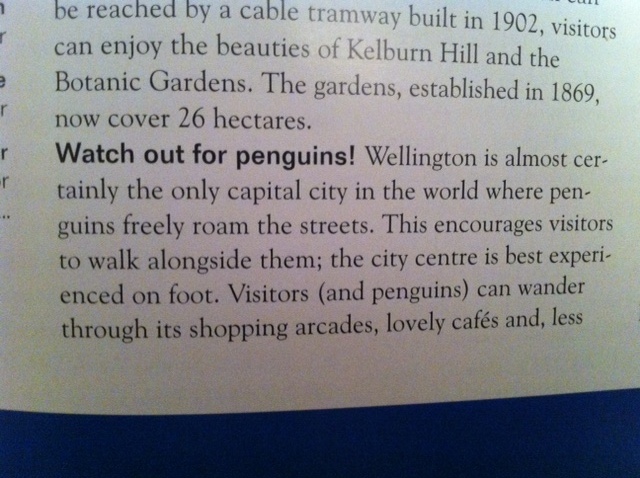
Before turning to Singapore and Bangkok, I flip through some of the other pages. I land on the very last page of the book, which happens to be none other than the World’s Coolest Little Capital™, Wellington City. A fine place to start my research, I decide. Like a true travel writer, I can note down some interesting titbits about my hometown and departure point, and then make comparisons to our destinations. “Wellington,” the book tells me, “is more than the political centre of the country.” So far so good. It’s only when I reach the next paragraph, that I understand why this book only cost me a crisp Ed Hillary. Under the heading ‘Watch out for penguins!’, it goes on to say that “Wellington is almost certainly the only capital city in the world where penguins freely roam the streets. This encourages visitors to walk alongside them.”

Penguins? Freely roaming the streets? Not last time I checked. Hang on – it could be a typo, I tell myself. Benefit of the doubt. Don’t judge a book by its talk of penguins, etcetera. I read on.

“The city centre is best experienced on foot. Visitors (and penguins) can wander through its shopping arcades, lovely cafes and, less happily, constant traffic.”

There it is in black and white, for a second time. Penguins. In Wellington. Are you for real, Mr Brenner? It's no wonder your book is now selling for $1.99 on the Barnes & Noble website.

In the words of Johnny Mac: You cannot be serious.
I come to the conclusion that this bogus travel book was written by someone who has clearly never visited the place. And so the age-old adage “Don’t believe everything you hear” rings true once again. I make a further mental note to myself to take everything I read over the next few months with a grain of salt, and to be as authentic as possible in my accounts of our travels.

Returning “100 Cities of the World” to the coffee table to claim its rightful role as a placemat and not a travel guide, I’m left with no option but to do a quick search on trusty Wikipedia to swot up on Singapore Airport and Bangkok ahead of Tuesday’s departure.

This second search proves much more fruitful (read: believable), and I learn that if we have more than five hours to spare at Singapore Airport, we could take a free city tour. “Even if stuck in the airport, there are plenty of ways to kill time.” Apparently Terminal 2 has an indoor garden, a music listening area with couches and mood lighting, a computer gaming room, a small movie theatre, paid massage services, and plenty of duty-free shops, while Terminal 1 has a swimming pool and jacuzzi, both open until 11pm daily. Excellent – sounds ideal, and (more importantly) factual. Something for everyone, and just the ticket for our stopover on the way to Bangkok.

Distrusted by uni lecturers the world over and an unacceptable reference source according to APA, Wikipedia – you complete me.

Thursday, December 15, 2011

Sleeps 'til Shanta


Not prime realty.
It’s 6.30pm on a Thursday evening and I’m sitting on the floor of the Jetstar baggage collection area at Auckland Airport. My friend Gemma’s kind offer of a free ride to the airport was too good to refuse, but I’m now in the unusual position of being far too early for my 9.00pm flight home. In search of a humble power socket for my laptop, I drag my obscenely large suitcase through every cafe and seating area in the vicinity. I search high and low, looking like I’ve lost something (my mind, mostly) but evidently, power sockets in airports are not as commonplace as I imagined. I locate one, but – most inconveniently – it’s already in full employment, giving the Bluebird vending machine the lifeblood it needs to distribute little packets of chippies and chocolate bars to weary travellers day in, day out. Plus, it’s situated at the door of the men’s toilets – not exactly prime realty.

After another five minutes, my increasingly frantic search proves fruitful and I locate the only other power socket in the domestic terminal – hence why I’m parked up on the floor right here at Jetstar baggage collection. Classy. Two turbaned taxi drivers are talking animatedly in Hindi nearby, and the volume and pace at which they converse gets me excited about the thought of my impending travels to the taxi drivers’ motherland; the chaos of cars, cows and commuters of Delhi is just a matter of weeks away.

The worn, industrial carpet tiles glued to the concrete beneath me isn’t the most comfy seat in the house, but I’m roughing it in the name of training for the all-important Surviving Airports module of Intrepid Travel 101. I’ll be back here at Auckland Airport on Boxing Day, before venturing further afield for a self-commissioned study of the prevalence of power sockets in airports of Asia. In fact, the next few months see me hanging out at airports in Singapore, Bangkok, Koh Samui, Kuala Lumpur, Chennai, Delhi, Kathmandu, Lukla, Christchurch and Wellington.

Power socket: located.
Tonight’s flight is my 71st in the 18 months since June last year, so I’ve spent a lot of time in departure lounges of late. It would be fair to say that 2011 has kind of been The Year of the Airport for Miss Communicate – not that there's any complaining. Some people whine to no end about the whole waiting around fiasco of travel, but truth be told – I kind of like it. It often seems to be the only time I can legitimately do nothing but engage in the fine art of people-watching. With the advent of smartphones, it seems every spare minute I’m not sitting at my desk at work (train rides, walking to the supermarket, on the bike at the gym, and so on) is filled in by some form of iPhone-based activity – and hence, people-watching time is now a much more scarce commodity. Airports provide for the perfect setting for the discerning people-watcher: teary farewells, frenzied folk running late, foreigners, exhausted commuters, security staff, and turbaned taxi drivers – airports have it all. But let’s not beat around the bush; while airports are an essential part of travel, and a terrific place for people watching, they’re simply a means to an end. The real attractions are the cities, towns, villages, mountains and islands we’ll visit, and – most of all – the fascinating people we’ll meet.

One of these people we’re going to meet is called Shanta Kumar Baniya – known simply as Shanta.

While most of the population is counting down the sleeps 'til Santa (10, if you haven’t already worked it out), I’m on the official countdown of sleeps 'til Shanta (just 42 more to go). Shanta is the Nepalese Sherpa who’s got the enviable task of spending 14 days with me, Pete, Tim and Clare. For the princely sum of 1065 Euros each, it’s his job to make sure we get to Mt Everest Base Camp and back to Kathmandu, ideally in one piece. We were introduced to Shanta through Sarah, a friend of a friend (FOAF). Apparently Shanta has been trekking in the Himalayas for 13 years, and has taken a friend of Sarah’s (so, a friend-of-a-friend-of-a-friend – a FOAF-OAF?) on a number of successful trips. FOAF-OAF says, “Shanta knows where the safe food is. By taking his advice, you will avoid stomach ailments.” This is a good start. “He is excellent at managing the altitude gain to avoid getting altitude sickness.” Even better. Shanta’s name, we’re told, actually has a silent ‘h’ – meaning that it’s pronounced exactly the same way as the father of Christmas himself. Upon hearing this, I immediately envisage endless Santa Claus-themed practical jokes, puns and re-written lyrics to Christmas carols (“Shanta Claus is Coming to Town” – a classic) as we suffer cabin fever in each other’s company and become delirious at high altitude. Poor guy – he’s probably heard it all before, but this will not stop me from ho, ho, ho-ing my way through our travels with him.

We’re led to believe that Shanta is a bit of a legend, and his emails to the four of us have proved to be unwittingly hilarious. Communicating with foreigners is a beautiful thing, and Shanta’s emails are testament to this. He alternates between several different spellings of words (often in the same email), and likes to address Pete as ‘Petter’ (his most recent email beginning, “There Petter” – Dear Peter?). Shanta diligently tells us in one email, “I am going to Everest trekking for 20 days and will come back after 20 days so that I will be out of contact for 20 days.” Right – got the message: 20 days. Item number 8 on the list of services that he’s agreed to provide us with is “8) First aid kid box service”. Kid box? No idea. Items 6 and 11 on the gear list are also most intriguing: “6) Worm shocks four pairs” (warm socks – four pairs?) and “11) Long wonder wear” (presumably thermals or long underwear – unless of course he’s into granny pants/wonderbras/Wonder Woman outfits – none of which I would deem appropriate for the Himalayan climate, but all of which would provide for entertaining photo opps. Particularly if the wearer is Tim, Pete, or our man Shanta). 

Ahhh, no.
Hell no!


But for now, my Intrepid Travel 101 training session is complete, and my biggest challenge is to regain the feeling in my backside, which is now numb enough to have minor surgery performed on it, sans anaesthetic. The turbaned taxi drivers speaking at a ferocious pace have since been replaced by a group of Aryan-looking German tourists, and one of them is holding a Macbook, eyeing up my power socket. So, I’ll do the decent thing and share a bit of power socket love with my fellow airport-dwellers, and tend to my now growling stomach. All going to plan, I’ll soon be rid of the pins and needles that have amassed in my legs, and will be able to stand up to face my current Everest – bypassing the hardworking Bluebird vending machine and its deliciously salty snacks and sugary delights in favour of a more nutritious form of airport sustenance. I’ll also take a quick look at the travel shop to see if they can shed any light on kid boxes or on sourcing some worm shocks. As for the granny pants and wonderbras? I’ll keep you posted.